
Related Initiatives
Pitt Center for Energy

The University of Pittsburgh’s Center for Energy is a university-wide endeavor that leverages the energy-related expertise of approximately 100 faculty members across campus from multiple disciplines and departments among the Swanson School of Engineering, the School of Computing and Information, Dietrich School of Arts and Sciences, Law School, Business School and the Graduate School of Public and International Affairs. Established in 2008, the Center is a unifying entity for faculty members to collaborate with each other, regional energy industry leaders, government agencies, and the community to address the many challenges and opportunities associated with the generation, transmission, and utilization of energy.
Advanced Magnetics for Power and Energy Development (AMPED)

AMPED is a consortium established in 2020 in partnership with North Carolina State University to advance the development of soft magnetic materials and components critical to modern power and energy systems. Bringing together researchers, industry partners, and educators, AMPED fosters an innovation ecosystem that accelerates the transition of new technologies from fundamental scientific discovery to real-world application. Through collaborative research, workforce development initiatives, and new educational programs, the consortium supports breakthroughs in magnetic materials, device design, and manufacturing, helping to strengthen the nation's capabilities in energy efficiency, electrification, grid modernization, and advanced power technologies.
Energy GRID Institute
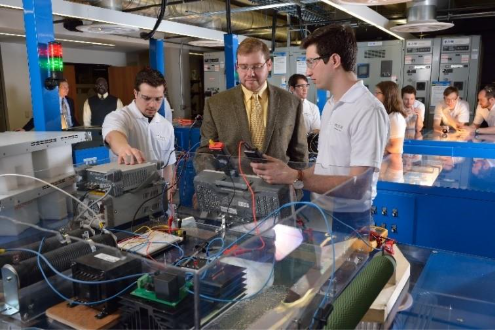
Energy GRID Institute (GRID) was launched in 2016 by the University of Pittsburgh to advance the development, testing, and demonstration of next-generation electric grid technologies. Located at the Energy Innovation Center in Pittsburgh, GRID serves as a collaborative hub where researchers, industry partners, utilities, and government stakeholders work together to modernize the nation's energy infrastructure through applied research and innovation. Anchored by a full-scale medium-voltage testing laboratory and state-of-the-art power systems facilities, the Institute supports research spanning grid modernization, microgrids, distributed energy resources, power electronics, system resilience, and grid cybersecurity. Through technology development, workforce training, and public-private partnerships, GRID accelerates the transition of new energy solutions from concept to deployment, helping to build a more reliable, secure, and intelligent electric grid.
Cyber Energy Center

Cyber Energy Center is a research and innovation hub established in 2024 through a U.S. Department of Energy award to advance cybersecurity at the intersection of operational technology (OT) and information technology (IT) in energy systems. Bringing together researchers, industry partners, government stakeholders, and educators, the Center develops solutions to address emerging cyber threats across the modern energy landscape. Through collaborative research, workforce development, and technology demonstration initiatives, the Cyber Energy Center strengthens the security, resilience, and reliability of critical energy infrastructure while supporting the safe integration of advanced digital technologies that power the nation's energy future.
University of Pittsburgh Center for Advanced Manufacturing (UPCAM)

The Swanson School of Engineering (SSoE) has determined that Advanced Manufacturing is an area of significant and future growth, requiring more focus and attention to maximize Pitt’s contribution to the field. The UPCAM focuses on organizing and coordinating research related to manufacturing science and Advanced Manufacturing, supporting both critical discoveries and students’ ability to participate in research efforts. By encouraging research collaboration, the UPCAM attracts some of the most renowned researchers in the field, including but not limited to Pitt faculty members.
RETI Consortium

The Resilient Energy Technology and Infrastructure (RETI) Consortium is an NSF-funded consortium led by West Virginia University, the University of Pittsburgh, Carnegie Mellon University, and the US Research Impact Alliance. The consortium has more than 60 regional partners, including Pitt’s Center for Energy. The National Science Foundation announced the award on July 14, 2026, providing up to $160 million over a decade as part of $321 million in combined public and private funding. RETI addresses challenges in energy transmission and distribution and improvements in manufacturing processes, and links Pitt’s energy initiatives with industry, national laboratories, and public partners to help advance major funded initiatives, technology transfer, and workforce outcomes. RETI has a branch office at the Energy Innovation Center.


