
About
How INSITES Was Born
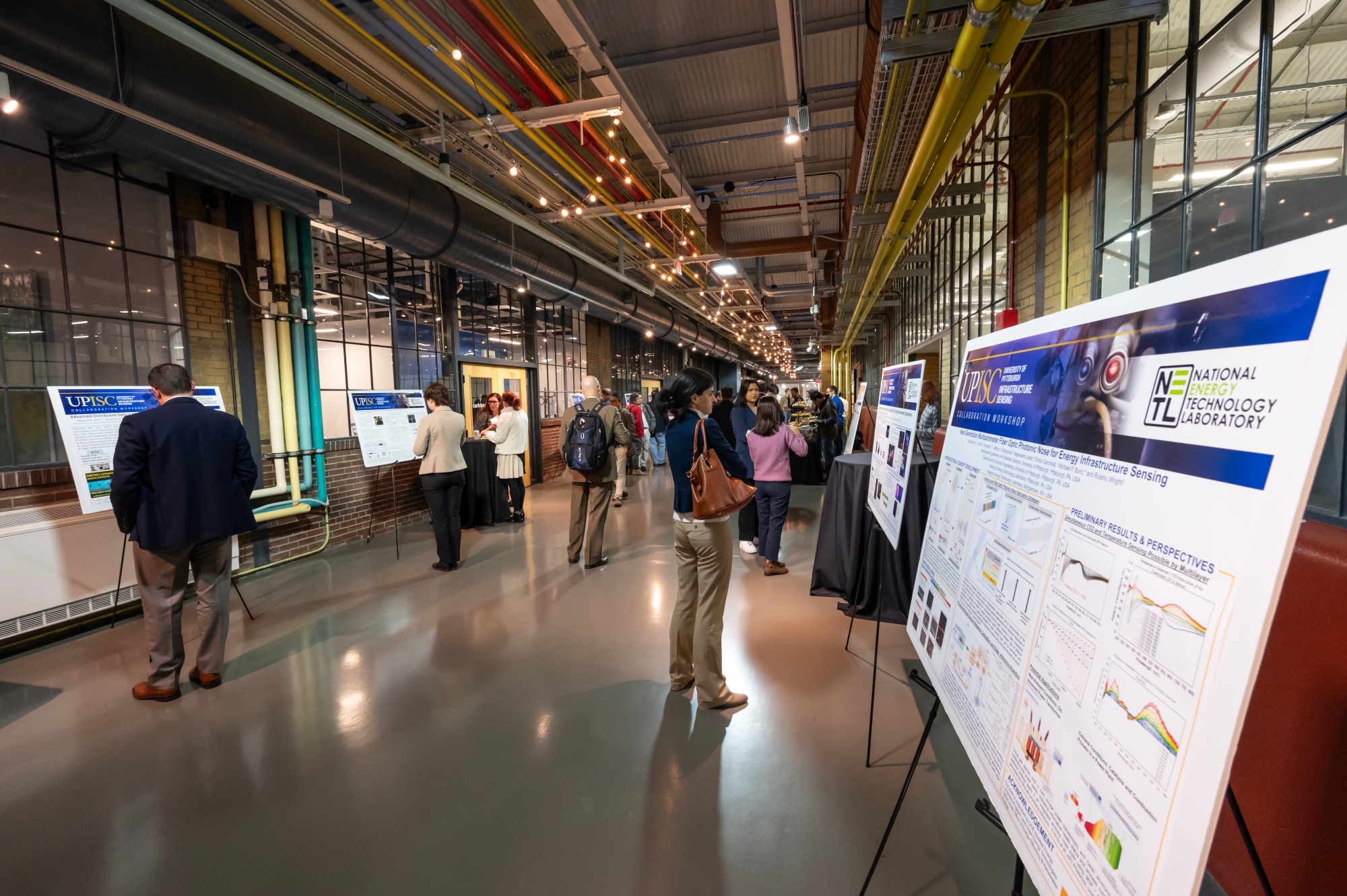
The INfrastructure Sensing for Intelligent Transportation and Energy Systems (INSITES) Consortium grew from a vision and eagerness for changing the reality of aging infrastructure across the country with novel and advanced sensor technology and systems. In August 2022, Prof. Paul Ohodnicki, then an associate professor at the University of Pittsburgh, and colleagues from Pitt and the National Energy Technology Laboratory (NETL) convened the first University of Pittsburgh Infrastructure Sensing Collaboration (UPISC) Workshop at the Energy Innovation Center (EIC). It brought together stakeholders spanning industry, government, and academia around infrastructure sensing, artificial intelligence, digital twins, and physics-based modeling. The attendees’ key action items included holding the workshop annually.
Momentum followed quickly. In December 2022 the UPISC steering committee prioritized next steps, led by a more formal collaboration, a possible National Academies study, and field testing of digital twins and distributed sensors. In January 2023, NETL and Pitt announced a memorandum of understanding to cooperate on novel sensors for infrastructure monitoring and on workforce development. The second annual workshop followed in November 2023.
In November 2024, the workshop became a National Academy of Engineering member-led workshop, adding policy at the local, state, and federal levels to the discussion, with about 120 attendees from more than 35 organizations. Its updated action items included establishing a formal participation agreement with partners and formalizing a consortium. In June 2025, Pitt announced INSITES, a formalized collaboration that establishes a research, education, and innovation ecosystem to prepare the next generation workforce and engage industry and government organizations in researching and deploying technology for intelligent infrastructure.
The 2026 UPISC workshop, held June 2–3 at the EIC, was sponsored by INSITES with seed funds from the Office of the Senior Vice Chancellor for Research. Industry participation agreements became available this summer, memberships are being established this fall, and member-funded research begins in 2027.
Previous UPISC Workshops
The UPISC Workshop is organized by a collaboration of the University of Pittsburgh and the National Energy Technology Laboratory, with the National Academy of Engineering joining as a member-led workshop in 2024. Over the years it has brought together diverse groups of industry, academia, and government peers with the common goal to discuss and advance topics related to intelligent infrastructure monitoring.




UPISC

The UPISC Workshop is organized by a collaboration of the University of Pittsburgh and the National Energy Technology Laboratory, with the National Academy of Engineering joining as a member-led workshop in 2024. Over the years it has brought together diverse groups of industry, academia, and government peers with the common goal to discuss and advance topics related to intelligent infrastructure monitoring.
Part of the Center for Energy

INSITES is a core center of the University of Pittsburgh’s Center for Energy. The relationship runs both ways. The Center gives INSITES a platform that connects it to Pitt’s other core centers, faculty across campus, the Energy Innovation Center laboratories, and partners such as the RETI Consortium. INSITES, in turn, demonstrates what a member-supported innovation ecosystem can accomplish, a model the Center hopes to extend.
Research Highlights
Our members are advancing six themes:
- Critical infrastructure sensing with digital twins (new). Distributed optical fiber and wireless sensors on bridges, such as the Smithfield Street Bridge in Pittsburgh, combined with finite element models, AI-based analytics, and digital twins to predict structural condition.
- Structural health monitoring for nuclear energy. Taking advantage of novel sensing technologies, INSITES members are building lifelong structural health monitoring systems specialized for the extreme and unique environments of nuclear reactor plants, transportation, and storage, to improve reliable and safe operation.
- Distributed chemical sensing for energy infrastructure. Whether detecting leaks along extensive chemical transportation infrastructure or determining environmental chemical composition and contamination over large areas, such as deep ocean locations, groups in INSITES are developing innovative fiber sensing capabilities for distributed chemical sensing.
- AI integrated with sensing. To bridge the gap between the complex, extensive data generated by advanced sensing and human processing capacity, INSITES collaborators incorporate AI and digital twin methods to expand sensing system capabilities, focused on high-precision sensing, multiparameter processing, and assisted interpretation.
- Dark fiber for geological monitoring. Taking advantage of the vast unused fiber networks across the country, INSITES groups are exploring how widely used fiber types can become distributed sensors for seismic activity detection and even radiation monitoring, with emerging partnerships such as DQE Communications.
- Electric grid sensing. The electric grid is vital to daily life, but the intense environments of many of its components make it hard to understand and monitor. INSITES members continue to develop more sensitive and precise multiparameter fiber sensors integrated with intelligent processing models to ensure the stability, predictability, and robustness of the grid.
