
Where a Classroom Meets Community

The University of Pittsburgh’s Liz Caruso teaches students to embrace uncertainty. In her course Innovating for Public Impact, students work in teams, collaborating with community partners to solve complex, real-world challenges.
In Spring 2026, students partnered with the Pennsylvania National Guard, the Pittsburgh Technology Council, and the City of Pittsburgh to improve emergency communications, strengthen technology ecosystems, and reimagine green spaces.
“Innovating for Public Impact is not your classic college course in that most of the learning takes place outside of the classroom,” said Anna George, a mechanical engineering student in the Swanson School of Engineering. “It requires going into the real world and solving a real problem. You get to see your work build from the earliest stages of problem discovery to the final product.”
From defense to public impact
Innovating for Public Impact grew out of Hacking for Defense, a course offered nationwide and taught at Pitt and Carnegie Mellon University. In fact, Pitt was one of the first universities to implement the program over a decade ago. Sponsored by the U.S. Defense Innovation Unit (DIU), the course gives students a framework for tackling real challenges facing the United States Armed Forces.
Caruso, a Pitt alumna who earned an MS in Health and Rehabilitation Sciences, spent seven years researching at the U.S. Army Natick Soldier Systems Center before working with the DIU, where she began collaborating with the two Pittsburgh universities. That relationship led Caruso to begin teaching the course at Pitt in 2023.
“I’ve learned that it’s not just the methodology that students want. They want to develop skills like presenting, interviewing, and applying the scientific method in more social ways,” said Caruso. “In addition to military challenges, they want to take on wicked problems like sustainability, ecosystem development, and climate change.”
Today, students choose a real-world challenge presented by a community partner. After learning the methodology and conducting mock interviews, they set out to interview ten people a week. From these interviews, they develop and deliver eight-minute presentations and then refine or rethink their recommendations.
Undergraduate and graduate students work together, bringing different experiences and strengths to their teams. While most participants are engineers, the course is open to students across Pitt. “The more perspectives and disciplines we can bring together, the stronger the solutions can be,” Caruso said.
From neighborhoods to the nation, tackling real-world challenges
At the federal and state level, Caruso’s students collaborated with the PA National Guard to improve communications between National Guard responders in helicopters with first responders on the ground during disaster recovery.
Students interviewed over 100 individuals, learning from local emergency management and FEMA officials, National Guard members, search-and-rescue teams, nonprofits, and the private sector. They even applied for and received DIU funding to visit Hawaii for three days to learn how the National Guard there coordinates with first responders.
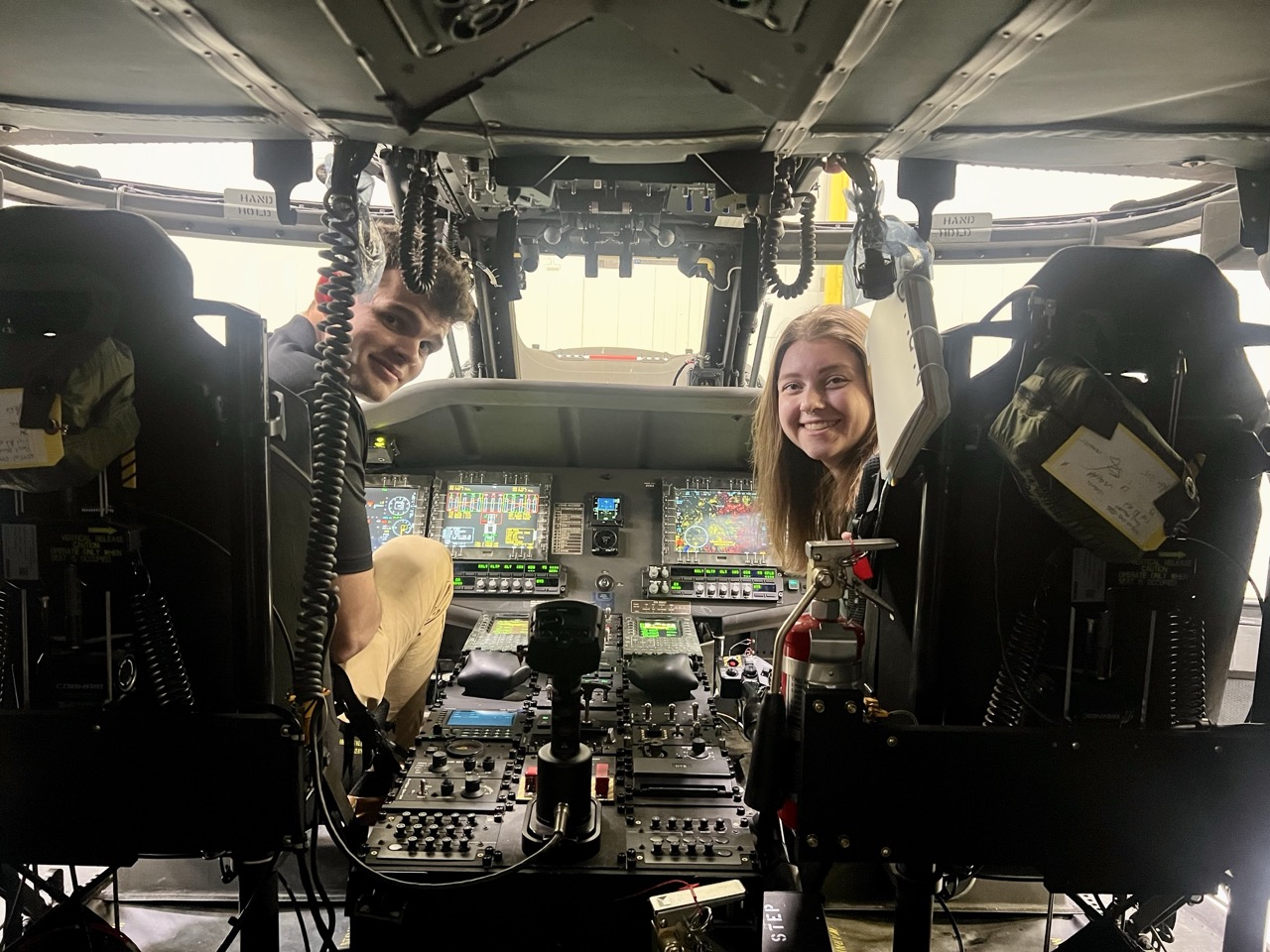
“It was an amazing trip. We met with 16 different individuals across seven organizations,” said Maria Alexander, a master’s student studying mechanical engineering. “The Honolulu Fire Department was more than happy to show us their operations, which were different from Pennsylvania. We could take what they do to help make better suggestions.”
At the regional level, students collaborated with the Pittsburgh Technology Council (PTC), a trade organization for Southwest Pennsylvania that supports local tech companies. Students helped the PTC build a stronger ecosystem that fully integrates all companies, no matter their size.
By attending events and interviewing PTC members and representatives from companies across the city, the team uncovered unique needs and barriers affecting emerging and established businesses. They developed a hub-and-spoke model that could connect emerging companies with the expertise and resources of more established firms.
At the local level, supported through a fellowship with Pitt’s Mascaro Center for Sustainable Innovation, the team worked with the City of Pittsburgh to explore sustainable uses for land in areas prone to landslides.
The students identified a plot in the historic and hilly Hazelwood neighborhood and began interviewing city officials and residents. They discovered what mattered most to the people living in Hazelwood, and the team narrowed its scope, creating a plan to transform an overgrown area into a usable green space.
Presenting solutions
After weeks of interviewing, iterating, expanding, sometimes even pivoting, students deliver their solutions. For their final project, they present to the class and their collaborators.
“The teams provide guidance and concrete steps,” said Caruso. “All of the partners valued having fresh eyes on their processes, and they all have plans to action for many of the recommendations.”
As Maria Alexander said, “Being engineers, we want to solve the problem first, but that's not how the class is oriented. We learn how to discover and understand the problem before we can even begin thinking about solutions.”