
Stronger Sensing, Smarter Energy Systems
Whether making grid-scale batteries safer, turning everyday telecommunications fiber into a sensing network, or developing clean-hydrogen systems that can sense their own health, University of Pittsburgh Swanson School of Engineering professors and their partner organizations are turning research into real-world solutions.
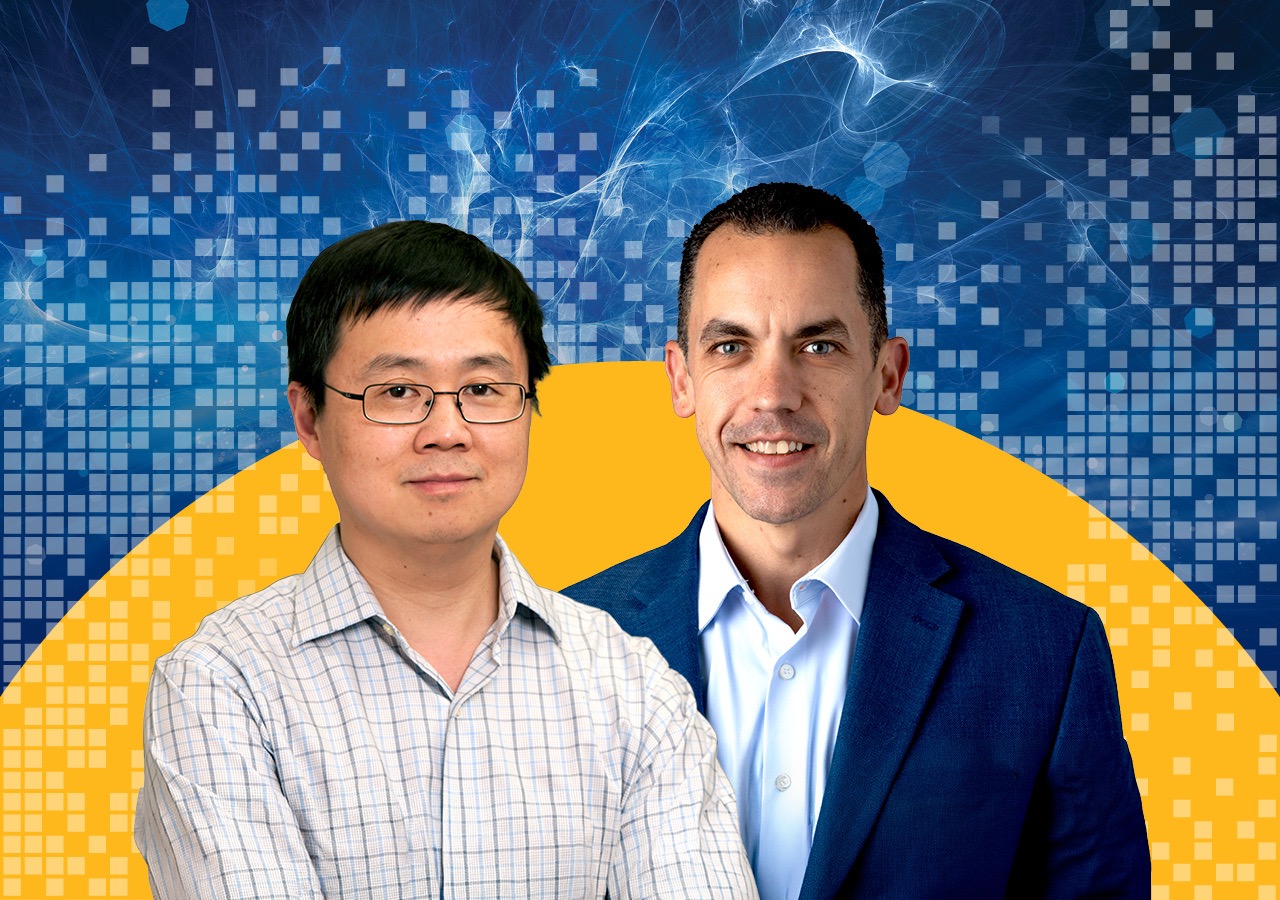
R&D World recognized Pitt professors Paul Ohodnicki and Kevin Chen and their collaborators with 2026 R&D 100 Awards for three emerging technologies: Photonic BMS, TeleSENSE, and REFLEX. Each year, R&D World magazine recognizes 100 of the most significant new products, processes, and materials worldwide.
“Receiving three R&D 100 Awards in one year is a tremendous achievement and highlights the innovative, collaborative spirit that thrives at the Swanson School,” said Heng Ban, the Richard K. Mellon Professor of mechanical engineering and materials science and interim associate dean for research and facilities.
Monitoring and managing grid-scale batteries
Co-developed with Ohodnicki’s Pittsburgh-based startup Sensible Photonics, Photonic BMS developed technology that monitors and manages grid-scale batteries, such as those used in energy-intensive AI data centers. These large batteries are essential in maintaining load and frequency regulation. However, a failure in one cell can set off a chain reaction that can spark a fire that engulfs the entire battery system.
“Photonic BMS uses fiber optic technology to provide passive monitoring of temperature and chemistry in real time, allowing facility operators to identify risks before it’s too late,” said Khurram Naeem, research assistant professor at Pitt, who helped develop the technology with Ohodnicki, postdoctoral researcher Yang-Duan Su, and graduate student Shovan Shrestha.
“In addition to the novel sensor hardware, Photonics BMS technology also includes novel algorithms for data fusion, data integration, and battery management system integration,” added Su.
“This award underscores the importance of university collaborations with small businesses, startups, and spin-outs through federal funding like the U.S. Department of Energy's Small Business Innovation Research program,” said Ohodnicki, professor of mechanical engineering and materials science at the Swanson School, R.K. Mellon Faculty Fellow in Energy, and director of the University of Pittsburgh Center for Energy. “A Phase I DOE SBIR grant to Sensible Photonics provided the catalytic capital required to develop and demonstrate this technology. The support and collaboration are vital to transitioning technologies from university laboratory concepts to impactful ideas in the marketplace.”
Funding support from the U.S. Department of Energy Office of Critical Minerals and Energy Innovation and an SBIR grant from the U. S. Department of Energy Office of Electricity was instrumental in the development and maturation of the technology.
Last year, Ohodnicki received two R&D 100 Awards and has been recognized five years in a row, for a total of eight awards over his career, including this year’s Photonic BMS.
Expanding sensing capabilities
TeleSENSE is a flexible manufacturing platform that uses a patented reel-to-reel laser process to transform standard telecommunications fiber into customized, high-performance distributed sensing fiber at substantially lower cost. The technology uses an agentic AI-enabled robotic manufacturing system to automate optical alignment, laser processing, and quality feedback.
“Our technology reduces labor-intensive fabrication while improving repeatability and scalable production,” said Chen, the Paul E. Lego Professor of electrical and computer engineering and the department’s vice chair for research. “The technology is designed to expand sensing applications across energy systems, infrastructure, telecommunications, robotics, and medical devices, while strengthening U.S. manufacturing capacity and competitiveness in advanced fiber-optic sensing.”
The technology was developed by Chen with collaborator Heng Ban and students Shuda Zhong and Emeka Ikpeazu at Pitt, Corning Incorporated, and Chen’s Pittsburgh-based AiMiLi Inc.
Building smarter, more-resilient clean-energy systems
REFLEX (Real-time Embedded Feedback and Layered Excitation) represents an ambitious new architecture for the hydrogen economy and next-generation power systems. Rather than treating solid oxide fuel cells and electrolyzers as passive stacks monitored from the outside, the technology embeds distributed fiber-optic sensing, electrical pathways, and active thermal-control elements directly into the interconnects at their core.
Developed by Chen in collaboration with Dong Ding, Directorate Fellow and Senior Advisor for the Hydrogen, Fuel Cells, and Electrochemistry Program, and colleagues at Idaho National Laboratory, as well as scientist Michael Buric and colleagues at the National Energy Technology Laboratory, REFLEX creates an intelligent energy-system platform capable of mapping internal temperature and strain in real time, detecting and mitigating hot spots, accelerating startup, and supplying the data required for predictive digital twins and closed-loop control.
By turning a traditionally passive component into the equivalent of a high-temperature battery-management system, REFLEX could help make hydrogen production, long-duration energy storage, synthetic-fuel generation, and resilient power systems more efficient, durable, responsive, and commercially viable.
“It’s an honor to receive these two awards,” said Chen. “It’s incredibly rewarding to see the research that began here at Pitt becoming a reality thanks to our collaboration with national laboratory partners.”
About the awards
For more than six decades, R&D World has hosted the annual competition to highlight groundbreaking innovation from around the world. This year’s winners were selected from 149 finalists in six categories. The 2026 honorees will be recognized at an award gala at the Grand Hyatt Scottsdale Resort in Arizona on November 19, 2026.