
Signals and Systems – and a Sax
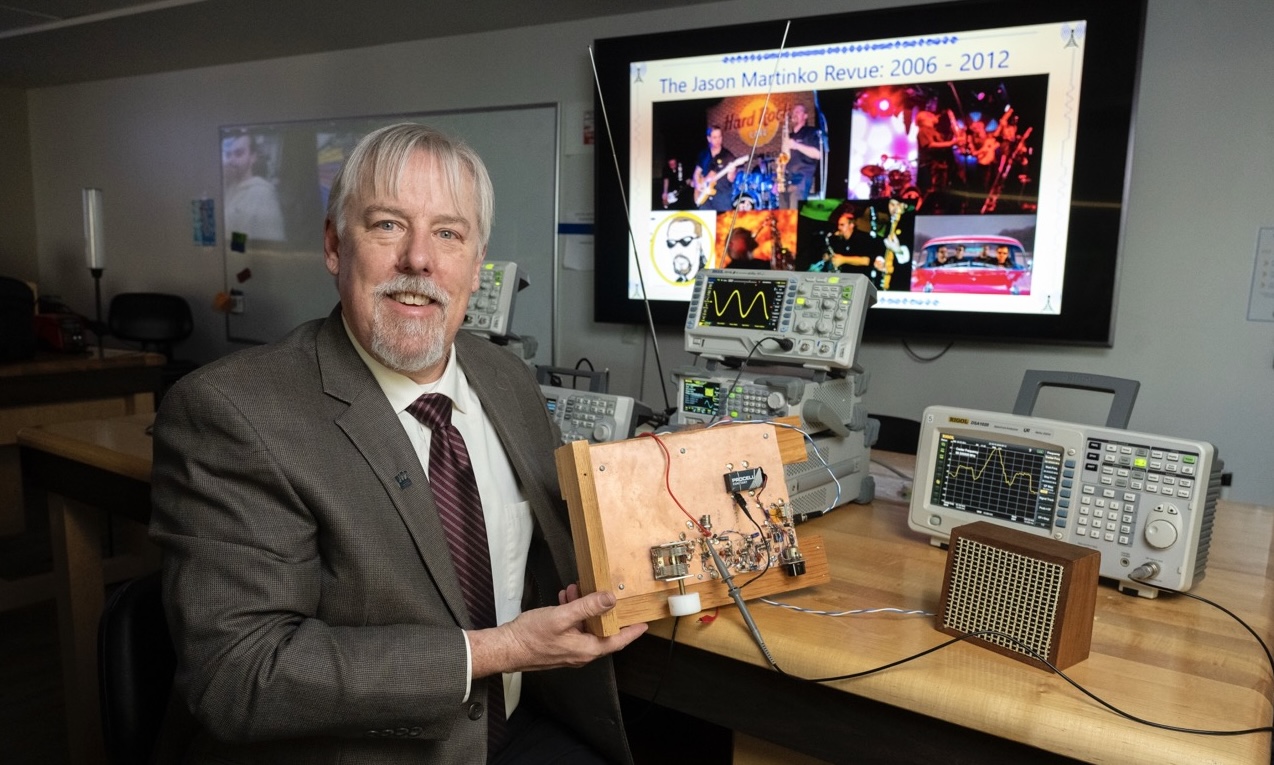
Steven Jacobs has been around radios his entire life. His father, Paul Jacobs, designed them and launched three companies that built systems for data communication. Jacobs worked at these companies over many summers and was fascinated by the technology that could send and receive bits of data through the air.
Engineering intrigued Jacobs, but he hesitated to pursue it until a college course and its professor won him over. The experience set Jacobs on a path to devote his career to teaching electrical engineering at the University of Pittsburgh Swanson School of Engineering.
This past May, after three decades in the classroom, Jacobs retired, but he leaves a legacy of engaging and challenging his students, mentoring junior faculty, and occasionally surprising them all with his saxophone.
Signals and Systems
Jacobs grew up in Chicago and moved to a suburb of Rochester, New York, as a teenager after his dad took a job with Harris Corporation, which produced technology like wireless equipment and tactical radios.
After high school, he returned to the Midwest to attend Washington University in St. Louis, where a Signals and Systems course taught by Professor Donald L. Snyder would alter Jacobs’ trajectory.
“Signals and Systems is foundational for students interested in any kind of signal processing, especially communications and control systems,” Jacobs said. “It’s also a famously difficult course.”
Yet Jacobs said that Snyder made the material accessible and inspired in him something more than just an interest in the material: he showed Jacobs the power of good teaching.
“He was an outstanding instructor, really gifted at grabbing your attention and leading you through difficult material so you understood it,” Jacobs said of Snyder. “That experience had a huge influence on me in terms of being excited about the field and in trying to be an instructor who inspired students the way he did.”
The teaching track
Jacobs would go on to earn his BS and MS in electrical engineering at WashU, and as a master’s student he met his future wife, Julie Fiez, who was studying psychology and neuroscience.
After beginning his PhD studies at Northwestern University, Jacobs returned to WashU to earn his degree, investigating how automated radar systems could recognize different types of aircraft. While the problems he wrestled with fascinated him, Jacobs realized that it was teaching that captivated him the most.

In 1997, Jacobs and his wife both accepted jobs at Pitt, with Jacobs hired as a visiting assistant professor in the Department of Electrical and Computer Engineering. Jacobs said that he thrived on teaching and engineering education. He became an assistant professor and in 2016 was promoted to associate professor, the same year that he received the Swanson School Educator of the Year Award.
“Steve is one of the most influential educators that I’ve ever had,” said Samuel Dickerson, associate professor of electrical and computer engineering and Vice Chair for Education and Director of Computer Engineering Undergraduate Program. “I was one of his students, and he taught the class that I now regularly teach. I modeled much of my teaching style after his and even now still use the notes that he used to teach me digital logic circuits.”
Added Dickerson, “Steve is known as the most rigorous faculty member we have. He is also one of our most beloved and celebrated educators by both faculty and students.”
The power of a well-documented lab
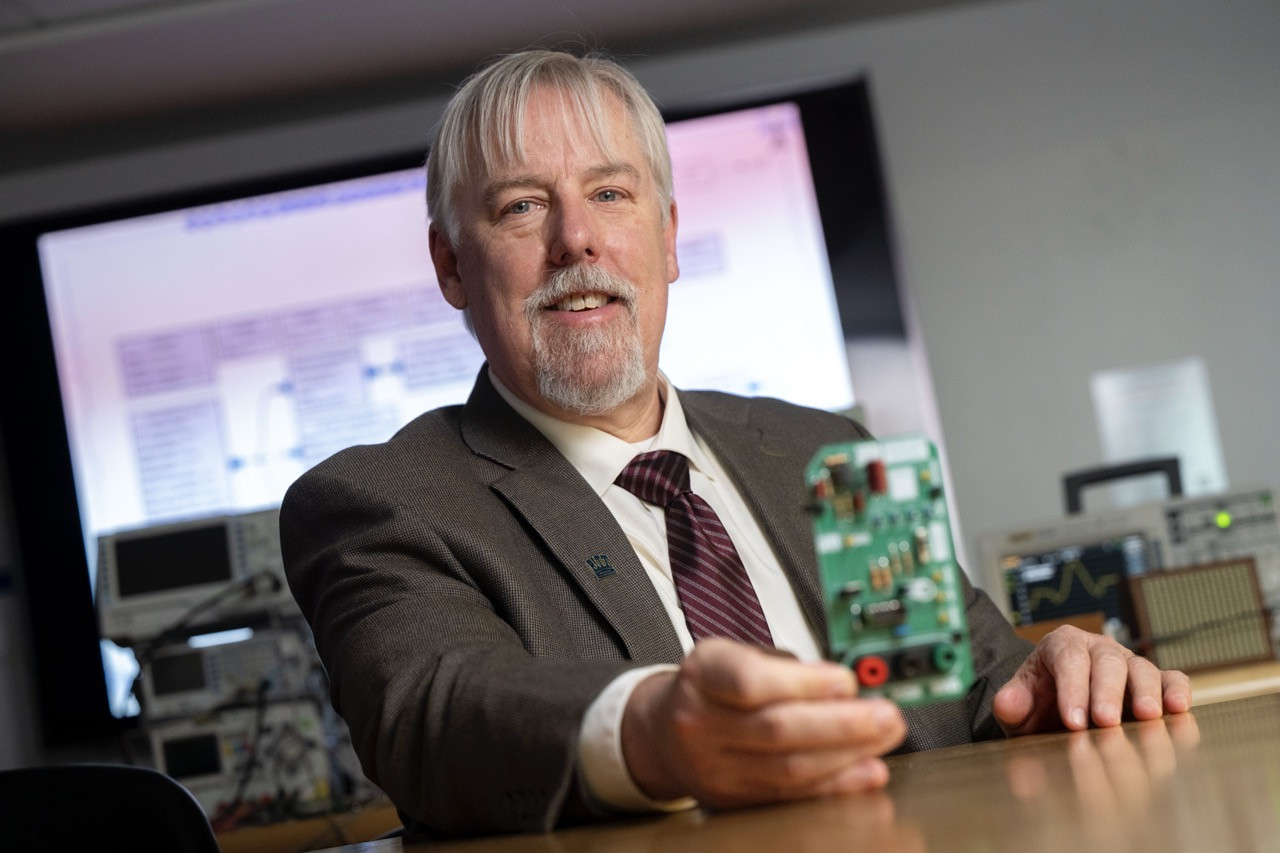
Essential to Jacobs’ teaching philosophy is a belief that students should learn by doing, which starts with well-documented labs. “Everywhere I’ve gone, I’ve built labs for courses and written documents to describe what the students should do and learn.”
While at Northwestern University, where he took as many teaching assistant positions as possible, Jacobs encountered mimeographed handouts that had been passed down year to year and served as the labs for the circuit courses. In what would become a hallmark of Jacobs’ career, he set to work rewriting and updating all the documents for the labs, providing detailed explanations, on his own initiative.
At Pitt, he would do the same for the courses he taught. If labs existed, he’d create new documentation. If there were no labs or too few, he would build them from scratch.
“In the last year and a half, for my digital communications course, which I've taught for years, I developed a new series of demos,” Jacobs said.
He created computer programs that students use to learn about error-correcting codes, the protocols that detect and correct errors that can arise when bits of information are sent wirelessly. Students experiment with the codes, including those used on the Voyager spacecraft to reconstruct digital images sent from outer space.
“Even if it’s not a lab course, I always like to put things like this into my classes,” Jacobs said. “These activities are opportunities for the students to apply what they've learned because, you know, that's the reason why they're here as engineers.”
“Dr. Jacobs was passionate when it came to teaching analog communications,” said Jacob Jones, who is a second year master's student in electrical and computer engineering. “He would write equation after equation, derivation after derivation on the board that he made seem almost like art. We were in for a treat when he wheeled in equipment that was probably older than all of us just to show off a simple concept. His classes may have been hard, but we always walked away learning something new.”
Jacobs’ belief in engaging his students has extended beyond the classroom. In 2014, he became a faculty advisor for Pitt’s Beta Delta Chapter of Eta Kappa Nu (HKN), the honor society of the Institute of Electrical and Electronics Engineers. Participation in Pitt’s chapter had waned. Recognizing the importance of fostering community and support in the program and across universities, Jacobs, with colleague Amro El-Jaroudi, helped rebuild the chapter.
“There were many people who didn’t see value in our chapter and in HKN as an organization,” said Sabrina Helbig, a Pitt PhD student in electrical engineering who held many leadership positions in the honor society. “I could tell that Dr. Jacobs cared. The success of our chapter mattered to him because he saw its potential and because it mattered to us. Having respected, visible, and caring leaders made such a difference.”
Indeed, by 2023–2024, the chapter received an Outstanding Chapter Award, the society’s highest honor.
“Steve has been such a valuable part of our program and has made a lasting impact on his students and colleagues,” said Alan George, department chair, R&H Mickle Endowed Chair, professor of electrical and computer engineering, and founder of SHREC and Pitt Space. “Through example, generosity, and creativity, he has been an amazing mentor to our newer faculty, especially to our teaching-track professors. I wish him all the best in his retirement.”
The sax
In the morning after the Swanson School spring graduation ceremony, Jacobs woke up and thought, “I don’t have anything I need to do today. How is that?”
What Jacobs did that Sunday morning was work on creating another lead sheet, arranging the parts he and fellow horn players use while performing.
Jacobs began playing the saxophone in fifth grade and played in marching and jazz bands in junior high and high school. While in graduate school, he received a phone call from a fraternity brother whose rock band needed a horn section. Jacobs grabbed his sax and joined.
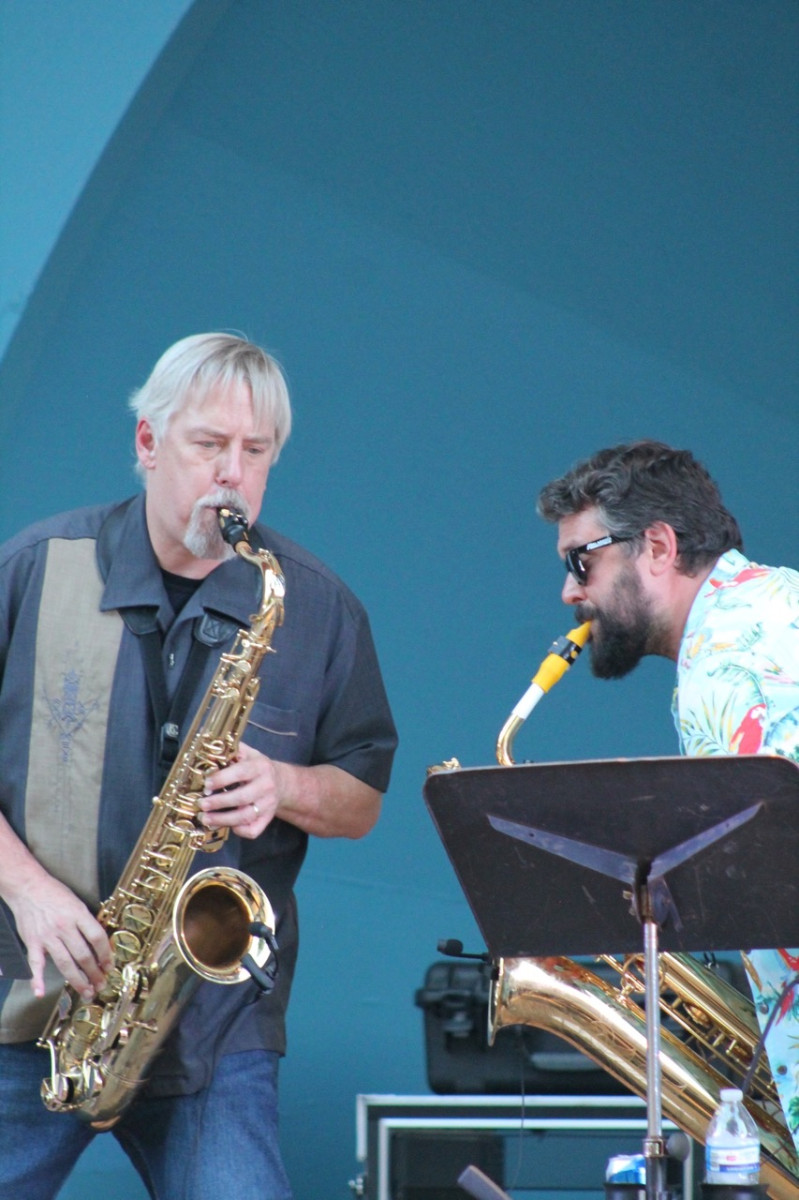
After moving to Pittsburgh, he played open mics until 2006, when he joined a rockabilly band that lasted until 2022. In 2019, he also joined a Blues Brothers tribute act, the Fabulous Booze Brothers.
Jacobs has increasingly become interested in arranging original songs. Using open-source software, he creates full charts. “I've made probably 30 charts in the last six months, entire songs – what all the horns have to do in every measure,” he said.
Whether he is designing and documenting new labs or new songs, Jacobs heads into retirement still inspired by his students and fueled by his fascination with sound, signals, and systems.