
At “Powering What’s Possible,” Pitt Opens a Conversation about Pittsburgh’s Energy Future
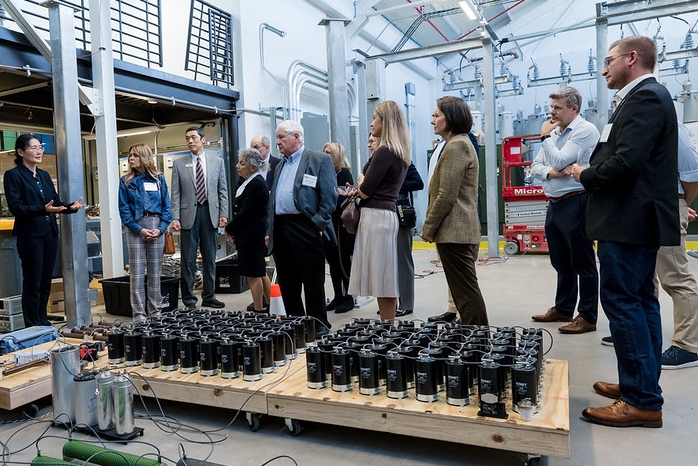
U. S. Steel Dean of Engineering Michele V. Manuel told guests that the region can do for energy what Silicon Valley did for computing, and she asked the companies in the room to help make it happen by working with Pitt faculty and students on problems in their own operations.
At its Powering What’s Possible event on Oct. 28, the University of Pittsburgh Swanson School of Engineering invited industry, government and community leaders to help shape the region’s energy future.
Speaking at the Energy Innovation Center (EIC) in Pittsburgh’s Lower Hill District, U. S. Steel Dean of Engineering Michele V. Manuel outlined an ambition for Pitt and its partners: establishing a national flagship for energy solutions that could help make Pittsburgh the nation’s energy capital. There was strong industry engagement from partner companies including CNX, Duquesne Light, Eaton, Emerson, EQT, Leidos, Peoples Gas and Westinghouse, as well as the Richard King Mellon Foundation.
The Swanson School’s new strategic plan also seeks to elevate energy as an area of research distinction, advancing the broader goal of establishing national leadership in energy research and innovation. Manuel described Pitt’s work across natural gas, nuclear power, renewables, energy storage, the grid, cybersecurity and artificial intelligence.
“We can make our region the nation’s energy capital,” Manuel said. “Just as Silicon Valley helped define the future of computing, our region will define the future of energy.”
“Reliable, affordable energy helps determine where manufacturers and data centers invest and what families pay in utility bills,” she added. “Grid resilience is a national security issue. Energy systems must meet rising demand and withstand extreme weather and cyberattacks while reducing emissions.”
America’s City of Engineering
Manuel further connected that ambition to “America’s City of Engineering,” a brand the Swanson School is advancing for Pitt and the region. It makes the case that engineering is one of the principal ways the region was built, industrialized, repaired and reinvented, resting on three claims: Pittsburgh’s place in the founding generation of American engineering education, marked by Pitt’s first engineering graduates in 1846; engineering practice sustained across major technological eras since; and a present-day concentration of universities, laboratories and companies in fields from robotics and health technology to quantum science and energy.
Manuel tied energy to that history. As the Swanson School marks 180 years of engineering education at Pitt, she said, energy remains a defining part of the region’s shared identity: Pennsylvania’s coal, steel and manufacturing fueled the first Industrial Revolution, and the Commonwealth can now build the energy foundation for the next.
Rich Fitzgerald, executive director of the Southwestern Pennsylvania Commission and former Allegheny County executive, said the region that helped build the nation’s industrial infrastructure now must help to build the digital infrastructure the world is demanding, which will require new energy technologies. Pitt’s work, he said, has “powered innovation for this region to move forward.”
“Most importantly, our universities provide the talent we need to move this industry forward,” Fitzgerald said. “It is imperative for our universities, industry and government to work together on the energy and digital infrastructure for the region.”
A Test Site for Industry
Pitt is the EIC’s largest tenant, and its Electric Power Technologies Laboratory, developed with Eaton, connects directly to Duquesne Light’s grid at 13,800 volts. One of only three laboratories east of the Mississippi with that capacity, it lets companies and utilities test equipment under operating conditions with Pitt faculty and students.
Pitt’s university-wide Center for Energy, directed by Paul R. Ohodnicki Jr., RK Mellon Faculty Fellow in Energy and professor of mechanical engineering and materials science, coordinates research with industry, government and national laboratories.
“We have over 100 faculty members working in the area of energy,” Ohodnicki said. “This diversity of expertise goes beyond engineering to include law, business, public policy, and computing and information, to name a few.”
During the event, guests toured labs and exhibits featuring the center’s four core research groups: the AMPED and INSITES consortia, the Energy GRID Institute and the Cyber Energy Center. Those groups work on magnetic materials and power components, infrastructure sensing, grid systems and protection against cyberattacks.
“We have extraordinary connections across the entire energy industry,” said Rob Rutenbar, Pitt’s senior vice chancellor for research and Distinguished Professor of Electrical and Computer Engineering in the Swanson School. “We see opportunities on both sides of the supply and the demand equation.”
RETI Extends the Partnership across the Region
Rutenbar explained that those industry relationships helped Pitt and its partners pursue the Resilient Energy Technology and Infrastructure Consortium, or RETI, which was selected in July as one of 12 new National Science Foundation Regional Innovation Engines. West Virginia University leads the consortium with Pitt, Carnegie Mellon University and more than 60 partners.
The award begins with $15 million over two years, with the potential for up to $160 million in NSF support over a decade as the consortium meets milestones. RETI projects 21,000 new jobs, roughly 150 startups and more than $1 billion in economic growth across West Virginia and western Pennsylvania. Pitt’s role includes expertise in grid sensing, security and advanced manufacturing. The consortium also has a branch office at the EIC.
Preparing the Energy Workforce
Workforce development at Pitt includes the new bachelor’s degree in Natural Gas, Renewables and Oil Engineering, or GRO. The country’s first undergraduate petroleum engineering program to pair oil and gas with extensive renewables coursework, GRO enrolled its first cohort this fall with 13 sophomores. Developed by Robert Enick, Covestro Professor and vice chair for research in the Department of Chemical and Petroleum Engineering, the program connects students with industry mentors, internships and co-ops. Enick also recruited industry executives and alumni from major related industries to assist with curricular development and student mentorship.
Ohodnicki asked partners to “lead, join, and build” with Pitt by serving on boards and advisory groups, joining its energy consortia and developing research and workforce programs with faculty and students. Manuel invited companies to work with Pitt on problems in their operations and supply chains and on training their workforces.
“Our region powered America’s past,” she said. “Together we will power America’s future.”
###