
Let the Bow Tie Speak
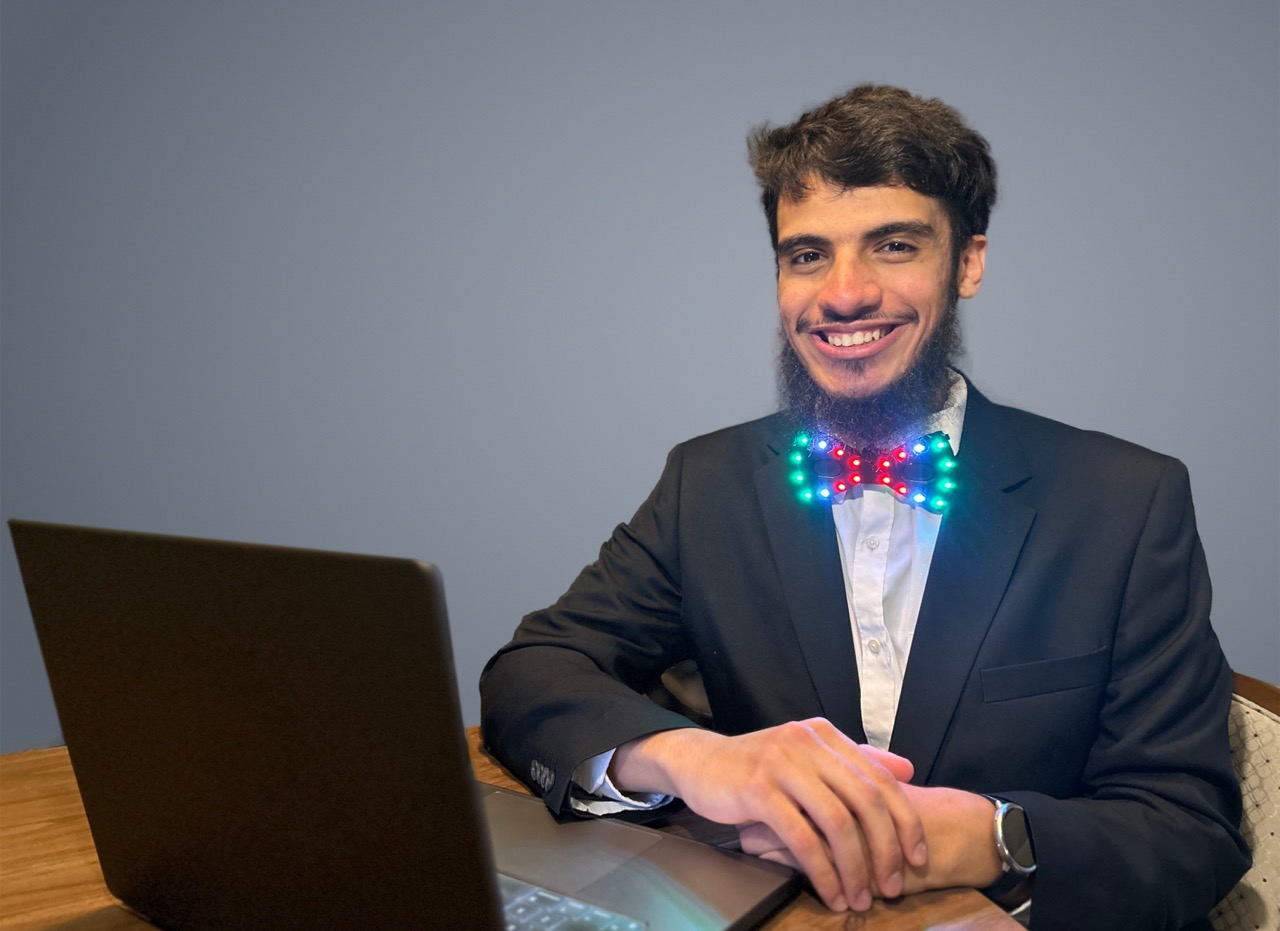
While people may appreciate a bow tie and wear one when the occasion allows, few have considered, let alone designed and built a bow tie-shaped AI assistant from scratch. But that’s what Oday Abushaban (BS ECE ’25) did. His love of bow ties inspired a years-long effort that involved retaking a course at the University of Pittsburgh Swanson School of Engineering and struggling with the constraints of a uniquely shaped printed circuit board (PCB). The result is Bowie, an AI assistant that knows it is a bow tie.
This past June, Bowie won first place in element14’s Spring Cleaning Competition, and it helped Abushaban land a job as a hardware designer at medical device startup Wearable Technologies Inc.
“Bow ties are unique and stylish,” said Abushaban. “I wear one at nearly every professional event I attend. When I had an opportunity to create a wearable, I knew what it had to be.”
Starting over
The idea for Bowie began in 2024, Abushaban’s third year at Pitt. That spring, he enrolled in ECE 1895: Junior Design Fundamentals, where students create three projects: a basic PCB, a simple toy, and a final project of their choosing.
Abushaban poured everything into the first project and by the time the second arrived, he was playing catch-up. While passable, the project fell short of his standards. The third one, as he said, “never had a chance. I was hungry to prove what I could do.”
He made a decision few engineering students would consider. He told his professor, Samuel Dickerson, that he was dissatisfied. Dickerson, professor of electrical and computer engineering, assured him he could pass with a decent grade, but Abushaban chose not to submit his third project. He would take the failing grade, retake the course, and “do it right.”
“It was never about the grade,” he said. “I wanted to learn how to be an engineer.”
That fall, he retook the course and, after a much more successful second project, he set out to build something entirely his own. With only four weeks left that semester, he knew he couldn’t build Bowie in full, but he could prove the idea was real.
“I developed a proof of concept,” he said. “A microphone and a Wi-Fi-enabled microcontroller on a breadboard, with a cloud backend that could capture a voice, send it to an AI model, and play back a response.”
Building a talking bow tie
For nearly a year, the project sat untouched. Yet Abushaban wanted to turn the tangle of wires and components into a real PCB. In fall 2025, he dug out the old breadboard and contacted Dickerson, who sponsored the independent study.
“The project combined everything I loved about electrical and computer engineering,” he said. “PCB design, embedded firmware, IoT architecture, and audio systems.”
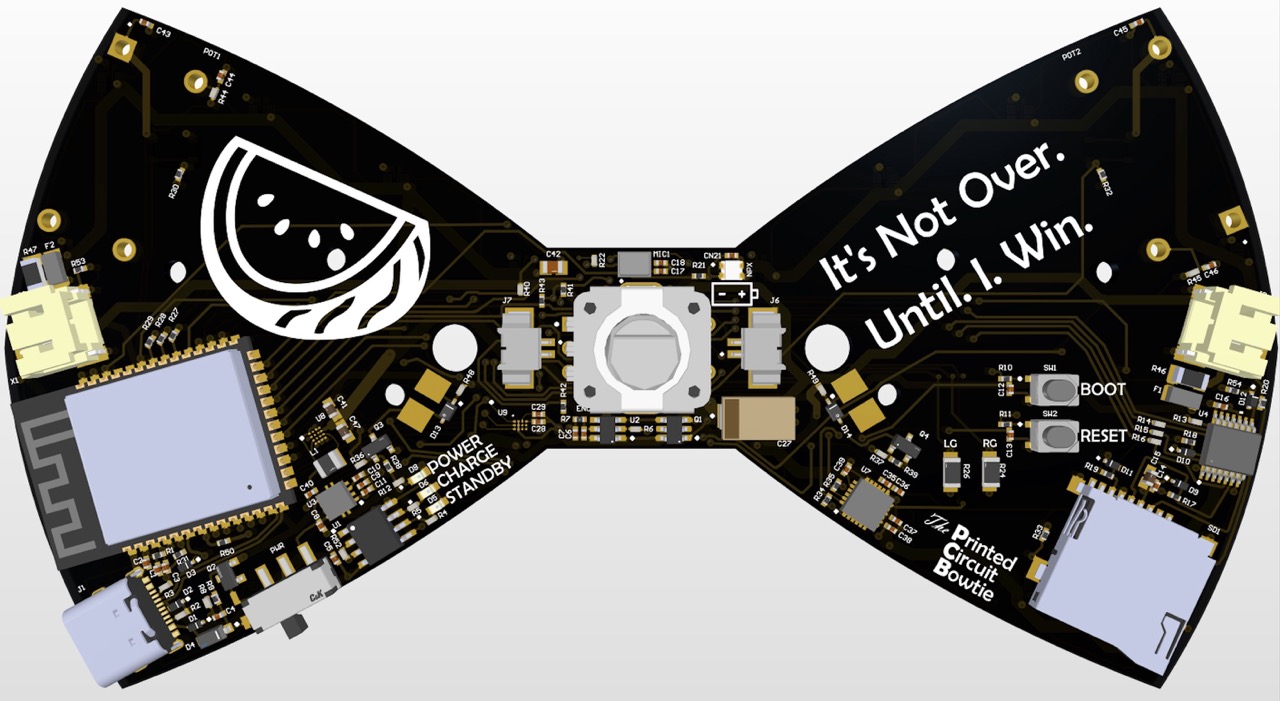
It didn’t come easy, and Bowie was still unfinished when he graduated in December 2025. “The form is unforgiving,” he said. “There are almost 200 components, requiring a four-layer stack.”
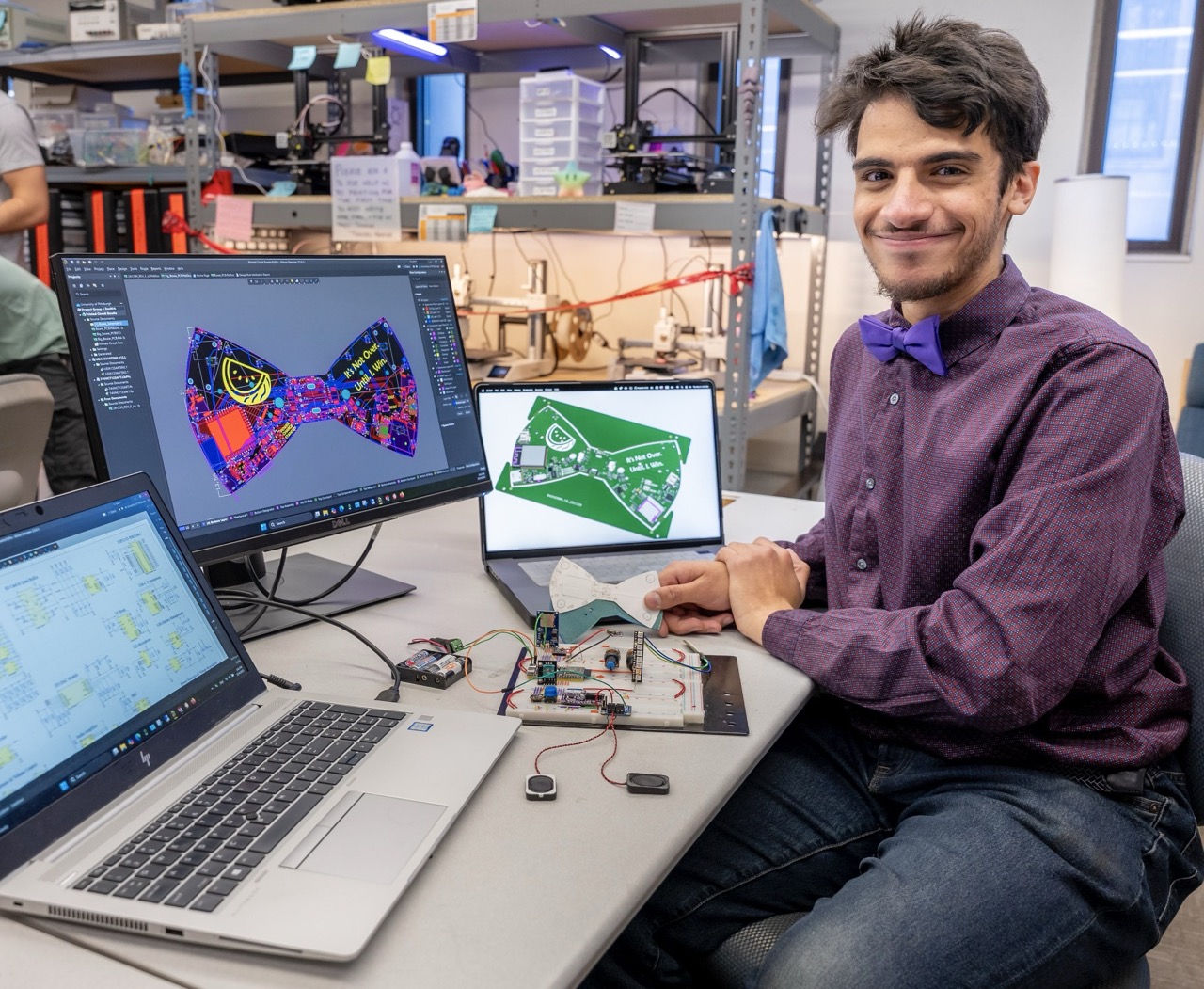
Undaunted, he kept working, even redesigning the entire PCB to fix an audio issue. By the end of March 2026, Bowie lit up when it was thinking, knew it was a bow tie, and could hold a conversation.
Abushaban returned to Pitt to show his work to Dickerson, whose faith in his student’s ability had served as a guiding light. Dickerson asked him to speak to his current junior design class about the project.
“I wore Bowie to the class, and as I told the story, the moment arrived,” Abushaban said. “I asked Bowie to introduce itself, and it lit up and spoke. Seeing the students’ astonishment was an amazing culmination of all my work. For four months since graduating, I’d been working on Bowie and sending out job applications.”
Two days later, he found Wearable Technologies, a company that needed someone to take ownership of its hardware. He wore Bowie to the interview.
“When they asked if I had experience with this kind of protocol or if I’d worked with that technology, I had the answer right here, around my neck.”
Bowie talked up its creator. He got the job.
Spring cleaning
Each year, element14, an online community for electrical and computer engineers, challenges members to finish and submit an old project in its Spring Cleaning Competition.
Although Abushaban was unsure about entering, on May 31, the morning the contest closed, he began documenting all he’d done, returning to his early setbacks at Pitt and the solutions he’d found. That evening, he submitted his project. A week later, he learned that Bowie had won first place.
For Dickerson, the recognition is well-earned. But it’s neither the award nor the technology that most impresses him. “What most stands out to me,” Dickerson said, “is Oday’s commitment to becoming a better engineer.”
That commitment continues at Wearable Technologies, where Abushaban works on AI-powered devices that detect falls and monitor the gait of seniors. He still improves Bowie in his free time, but the intricate systems he helps develop now must fit on a wrist.
Read the most up-to-date write-up and see Bowie in action on Abushaban’s portfolio.
For the original project submission, visit Bowie on element14.