
For Every Reaction, There’s an Action

Photo above (L - R): Toby Rozengarten, Connor Chadwell, Eli Sivick, Ben Hill, Luke Roup, Alette Kegerreis, Venkatesh Subramanyam, and Dawson Wenslovas
Video: Pitt's Chem-E Car the Lighthouse completes its race while an official walks beside it.
At first glance, the American Institute of Chemical Engineers (AIChE) Chem-E Car Competition may not seem that daunting: design and build a shoebox-sized model car powered and stopped by chemical reactions. The catch? Only one hour before competition, teams learn for the first time the distance their car must safely travel on its own. The car closest to that distance wins.
For over a decade, University of Pittsburgh Swanson School of Engineering students have been up for this challenge. Pitt’s Chem-E Car has weathered competitions where their car didn’t start or where it veered out of bounds or went backwards or wouldn’t stop. Yet the opportunity to build a battery from scratch, design and create a car, and devise a stopping mechanism continues to captivate Pitt students eager to hone their engineering decision-making skills.
This past spring, at the AIChE Mid-Atlantic Regional Conference, held at Virginia Commonwealth University, in Richmond, Virginia, the Pitt team’s car came .02 meters (an eighth of an inch) from advancing to the national competition in November, and the team hopes that it might get there yet.
Starting
“Three years ago, as a second-year student, I joined Chem-E Car because it was a hands-on opportunity to work with chemicals,” said Toby Rozengarten (ChemE BS ’26), president of the club this past year. “I liked the problem-solving aspect of it as well as the freedom to design what we choose.”
The heart of each Chem-E Car is its power source, and each year the team must decide what kind of battery. Standard lead-acid battery? Hydrogen fuel cell, or an electrochemical cell? How will it fit safely into a model car? And how much power will it provide?
Questions like these are answered collectively, with upper-level students mentoring newer members. Pitt’s team had 12 members this past year, and they decided to develop a lead-acid battery.
“We’d seen these batteries at previous competitions and wanted to make one of our own,” said Rozengarten. They develop a system composed of six electrochemical cells wired to deliver about 12 volts, more than enough to power the motor and gears.
Beyond the chemistry involved in building the battery, the team designs and creates the car, which this year included a lighthouse structure, which inspired the car’s name, Lighthouse.
“This was my first real experience working as a team to design and build something,” said Ben Hill, who just finished his first-year at the Swanson School. “It pushed me to learn things that weren't explicitly taught in the classroom.”
“Last year, we had an electrical engineer who did all our circuitry, but she graduated,” said Alette Kegerreis (ChemE BS ’26). “We needed to start from scratch, and I took the opportunity to learn something new. It was a great experience.”
It was also successful. Each year, around 20 teams compete in the Mid-Atlantic region, and of those teams, about half, sometimes more than half of the cars won’t even start. In 2024 and 2025, the Pitt team’s car didn’t make it past the start line.
This year, the team had to tune their car to reach 17.22 meters (56.6 feet). In the allotted hour, they calculated and mixed the chemicals, which they added to the reactor and the battery. They flipped a switch and the Lighthouse came to life. Staying within bounds, it began rolling, heading toward the finish line.
Stopping
Unlike a traditional car race, in the Chem-E Car Competition, speed isn’t as important as stopping. To qualify, a car must stop within three meters of the set distance.
To do so, the Pitt team turned to a process used at some crime scenes: chemiluminescence. “We used luminol, which helps investigators detect blood,” said Luke Roup (ChemE BS ’26). “The chemical compound reacts with the iron, producing a light-blue glow.”
The team built a reactor, which they placed atop the lighthouse. They used an iron-based catalyst, which would determine how long the light would glow. “We set up a sensor that reads the light’s brightness, and as soon as it’s not bright enough, the sensor shuts off the entire system,” Roup said.
Ostensibly, if the team mixes the correct concentration of reactants and catalysts, the car rolls to a stop at the finish line. And the team did calculate correctly… for the dusty floors of the Benedum Hall sub-basement, where they also share a space with researchers testing concrete.
“On the smooth surface at the competition, the Lighthouse kept going,” said Kegerreis.
It rolled past the finish line and came to a stop at 20.24 meters.
Waiting
In a competition where nearly half the cars don’t even make it past the starting line, to finish just beyond the outer bounds was both maddening and gratifying for the team.
“An eighth of an inch and we would’ve placed fifth,” said Roup. “The top five cars go on to compete in the nationals.”
The team has hope, though: they will apply to a waitlist. “The official judging our race told us that we need to apply, that we were so close to qualifying that we have a great chance of getting in.”
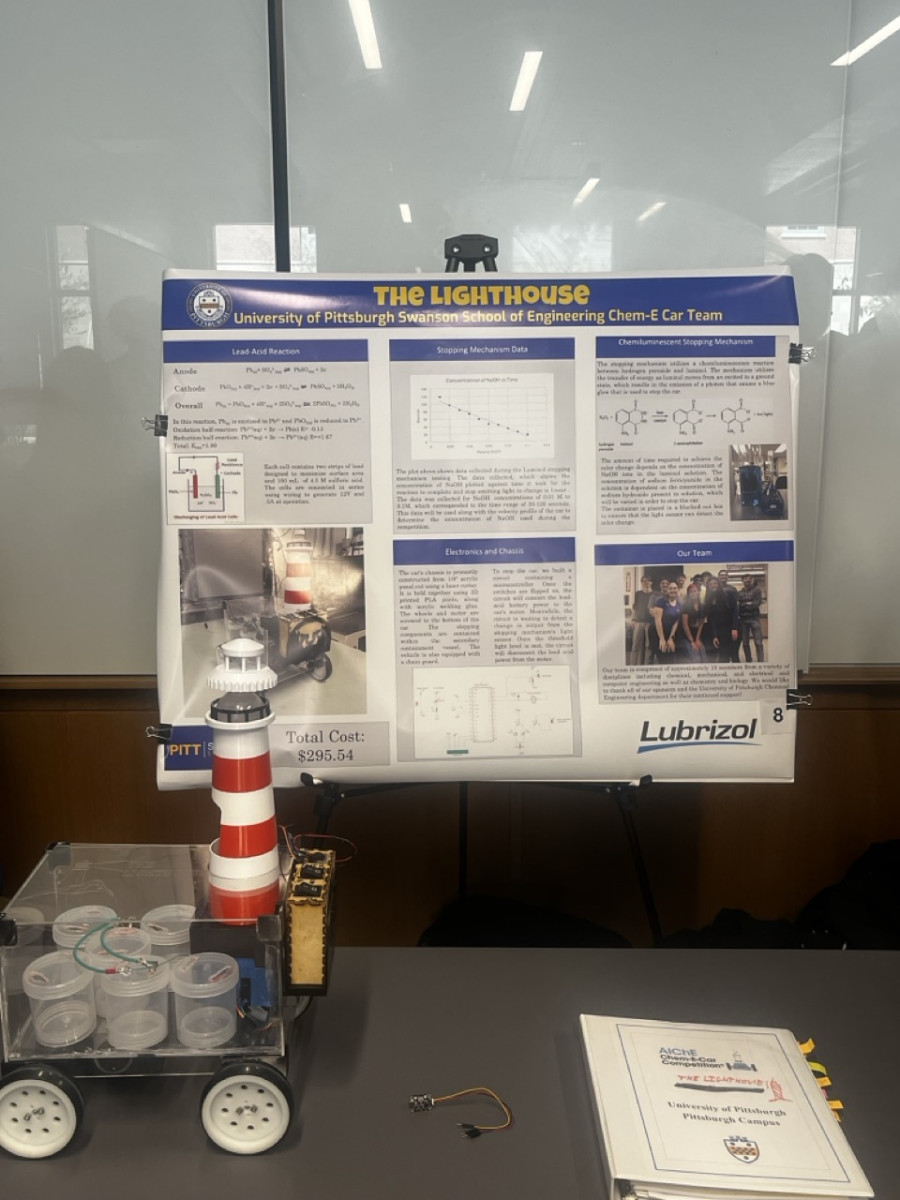
Even if they miss nationals, the experience has been extremely rewarding. The competition is about much more than starting and stopping a model car through chemical reactions. It’s about the creative, collaborative problem solving and decision making that occur all year. It’s about the connections that form in Benedum Hall and beyond. As part of the competition, teams present posters and share ideas. Pitt’s team fielded many questions about their unique stopping mechanism and the high voltage of their battery. Teams network. On race day, they cheer each other on.
“I’m so proud of our Pitt team,” said Taryn Bayles, professor and director of undergraduate education in the Department of Chemical and Petroleum Engineering. Bayles has been the team’s faculty advisor since 2016. “They were incredible representatives of the Swanson School, and their car reflects a creative, innovative approach essential to our program.”