
A “RARE” Opportunity
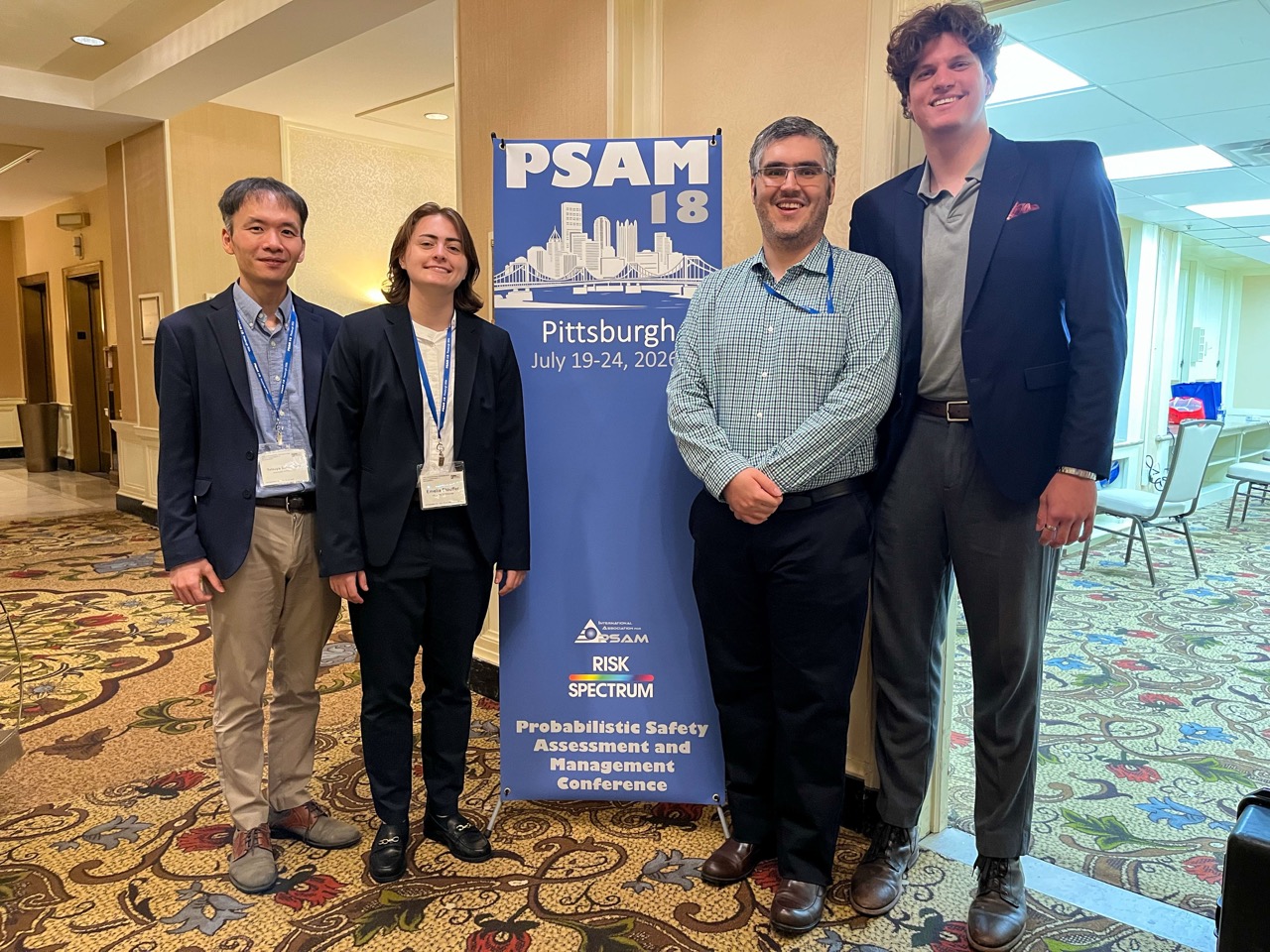
From July 19 – 24, Pittsburgh was in safe hands. More than 200 researchers from around the world dedicated to assessing and managing risk across critical infrastructure, the environment, and complex systems had convened for the International Association for Probabilistic Safety Assessment and Management’s PSAM 18 conference.
The University of Pittsburgh’s Tatsuya Sakurahara served as technical program chair for the conference, coordinating with 22 committee members to organize 220 presentations into 50 technical sessions. The conference gave Pitt students in Sakurahara’s Risk Analysis and Reliability Engineering (RARE) Laboratory the chance to present their research, network, and see the inner workings of a conference. For Emmie Stouffer and Krzysztof Radziszewski, the experience changed their trajectory.
“Today, with everything from technology to climate to the threat landscape changing so quickly, a conference dedicated to developing safer and more reliable systems is incredibly important,” said Sakurahara, assistant professor of mechanical engineering and materials science at the Swanson School of Engineering. Sakurahara combines probabilistic and non-probabilistic uncertainty theories and models to assess risk and improve safety and efficiency in nuclear energy systems.
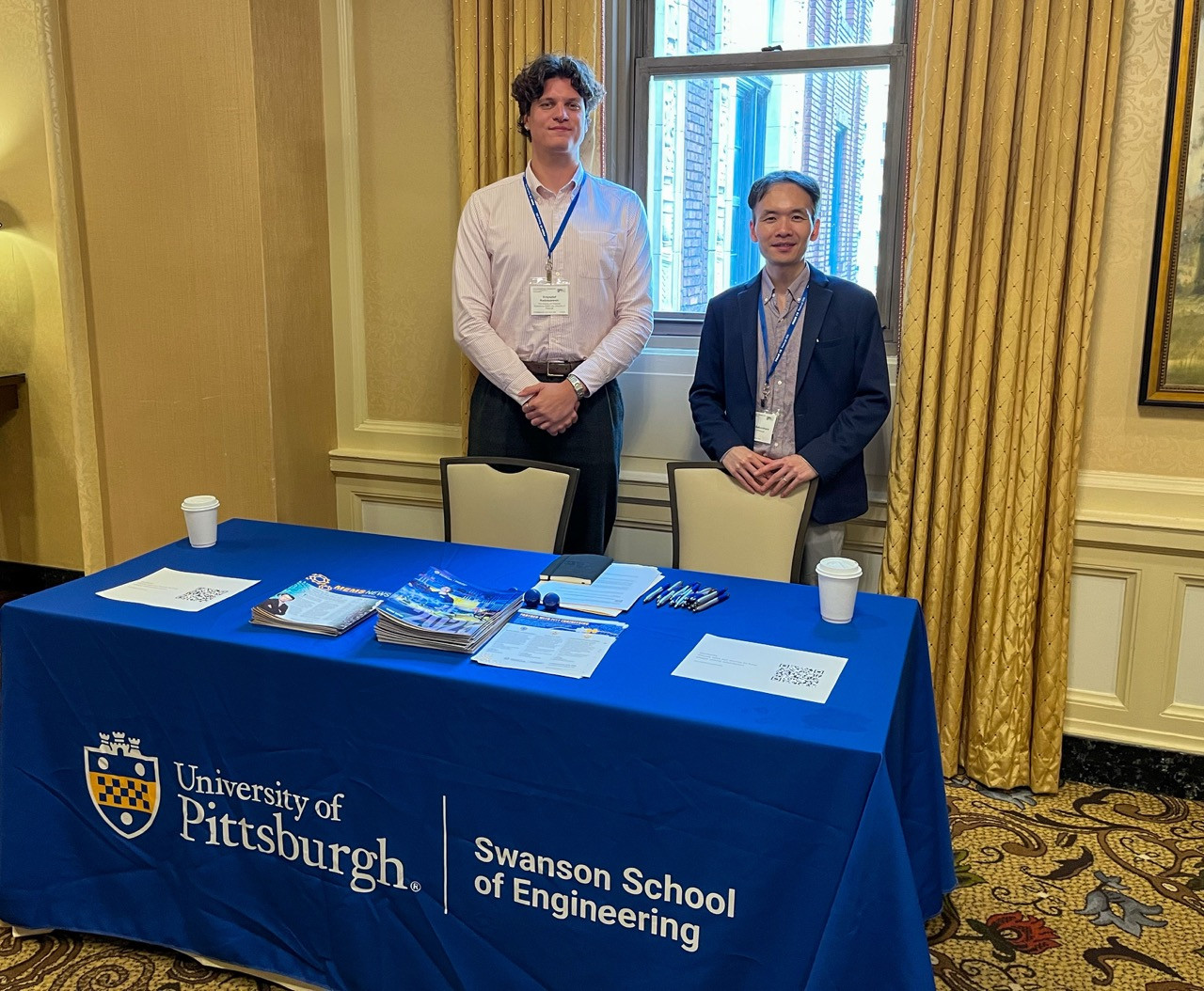
“PSAM is one of the largest international conferences in this field, and for my students who helped it run smoothly and who presented their research, it was a special experience,” Sakurahara added. “It was an honor to showcase Pittsburgh, the Swanson School, and its students.”
One such student was Emmie Stouffer. She has always liked math and statistics, and last year as she began looking for research opportunities, she was drawn to Sakurahara’s RARE Lab. “It's important to understand large systems and how they might fail and the probability of those failures, especially if you’re thinking about something like a nuclear power plant,” she said.
Stouffer reached out to Sakurahara and joined during the summer of 2025, the start of her second year as a mechanical engineering student. “Since joining, I’ve worked with a PhD student, designing a framework for a natural gas subnetwork of an integrated energy system. I’ve been building a Python code that can calculate the risk given various uncertainties.”
Prior to this July, Stouffer had never attended let alone supported an international conference like PSAM. “Just looking at the list of research labs and companies participating was incredible,” she said. “I met so many professionals from around the world.”
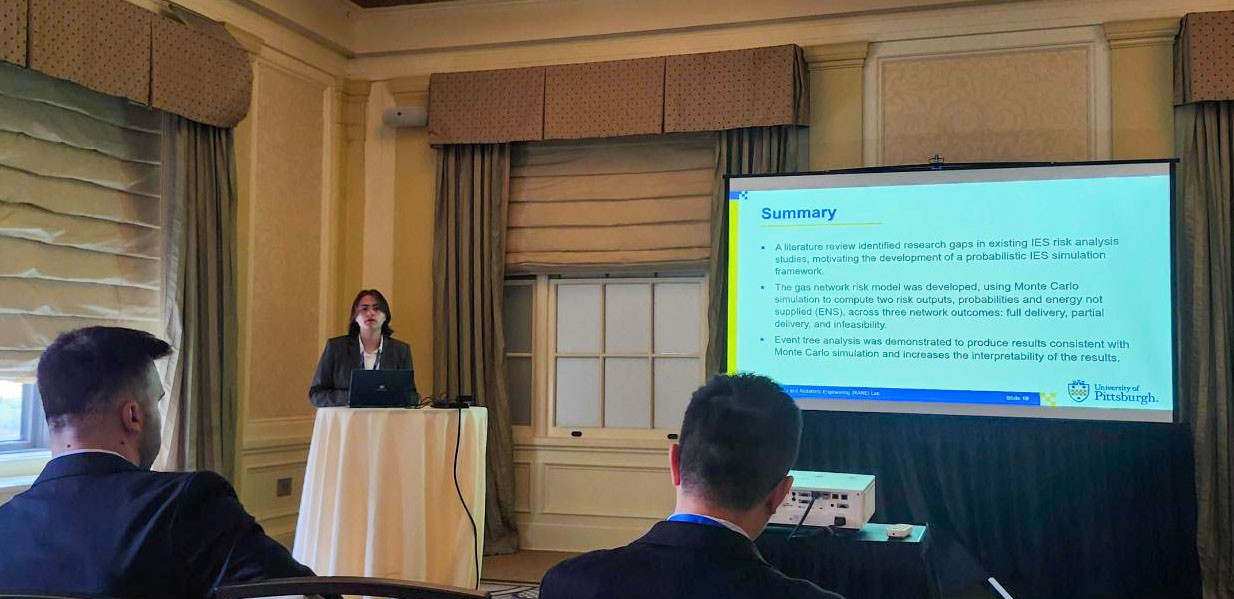
She also had the opportunity to present her research, “Probabilistic Risk Assessment for Multi-Network Integrated Energy Systems: Gap Analysis and Preliminary Results,” available on the research repository D-Scholarship at Pitt. For two weeks before the presentation, she would find an open classroom in Benedum Hall and deliver her talk to empty chairs.
“I was leaning towards going straight to a career after graduating,” she said, “but this conference helped me see how much I enjoy research. I can see myself continuing with it at the graduate level.”
Stouffer added, “I’ve always wanted to do something that makes a difference. At the conference and in the RARE Lab, that’s what I’m doing.”
Like Stouffer, Krzysztof Radziszewski joined the RARE Lab in 2025 and participated in the PSAM conference. A collegiate swimmer on Pitt's Swimming and Diving team who earned his mechanical engineering degree this May, he had little experience with risk assessment and probabilities or even laboratory research but, as he said, “Dr. Sakurahara gave me a chance, and here I am.”
Radziszewski began investigating uncertainty quantification in modern nuclear reactors, such as small modular reactors and microreactors. He set out to see how new forms of automation and digitization in these systems impact Human Reliability Analysis, which seeks to determine the likelihood and the consequences of human error affecting a complex system.
The work fascinated him. As Radziszewski said, “I fell in love with the field.”
His research resulted in an academic paper, in which he is the first author. “Quantifying and Reducing HRA Uncertainty in Advanced Reactors: Bayesian Inference Approach” is available on the research repository D-Scholarship at Pitt.
Like Stouffer, Radziszewski presented his work at the conference, an experience he found nerve-racking but rewarding. As he said, “I’d literally just earned my bachelor’s degree and was presenting to a room of experts.”
In addition to fielding these experts’ questions, he networked with them. “It was new to me, talking to researchers from peer universities, national labs, and industry, and it was super valuable.”
Before the RARE Lab and the PSAM conference, Radziszewski had considered pursuing a master’s degree, but that changed. “I applied for the PhD program, and this fall will continue working with Dr. Sakurahara in the RARE Lab,” Radziszewski said. “Dr. Sakurahara has been an amazing mentor, and I’m excited to continue my research to help keep complex systems safer.”