
Reluctant Researcher Turned First Author
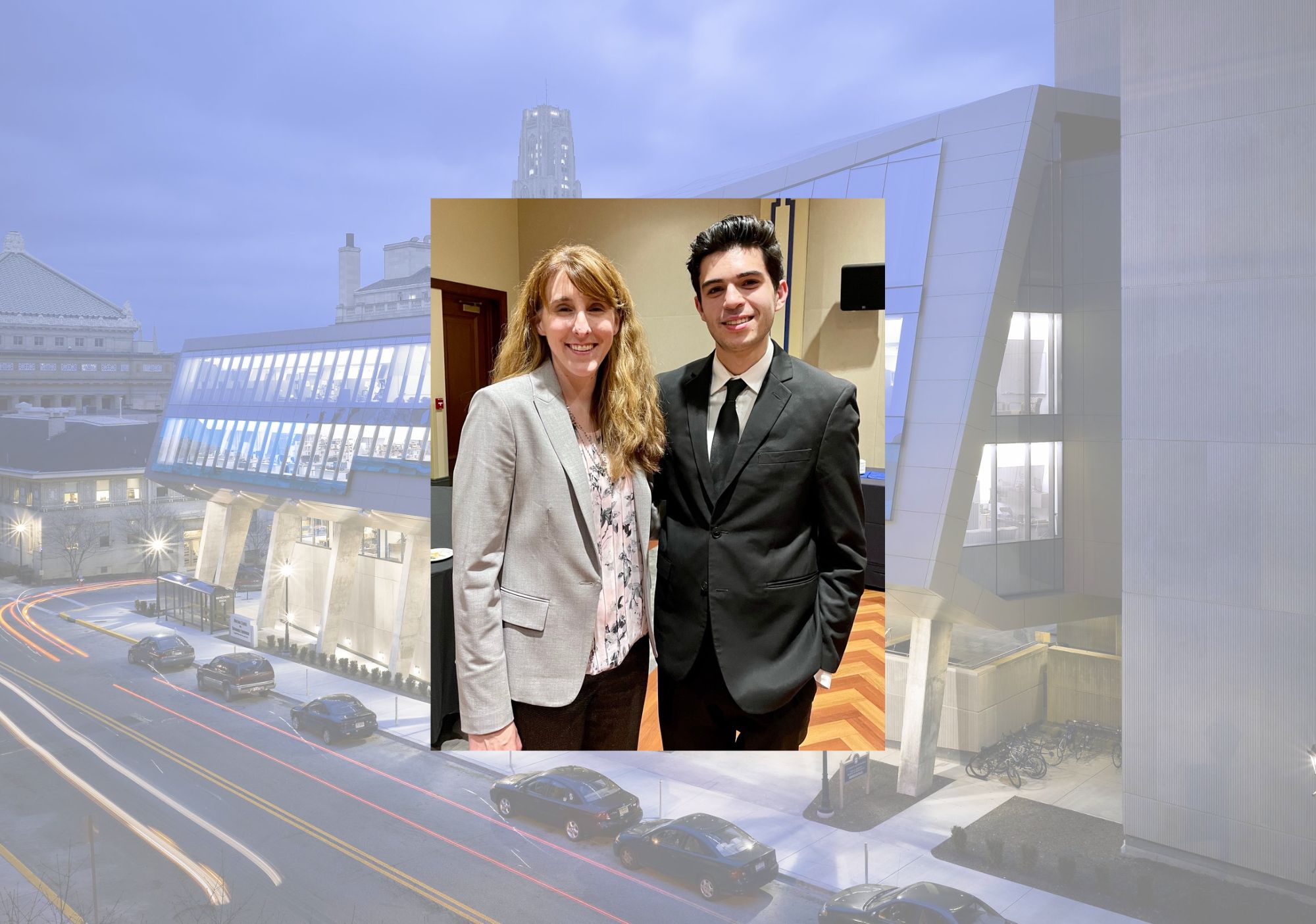
As Andrew Ashmar (BS ChemE ’22) entered his third year as a chemical engineering undergraduate at the University of Pittsburgh Swanson School of Engineering, he had a fixed idea of his future: straight into industry.
It was the fall semester of 2021 and as Ashmar said, “I’d just finished my final co-op rotation with The Sherwin-Williams Company, where I had the chance to do R&D work in a lab. I loved it.”
That all changed after a friend approached Ashmar about the opportunity to work on a project that could help reduce plastics in the ocean.
“My friend Jon [Bingaman] had been doing undergraduate research looking at algae-based bioplastics, and he encouraged me to take it over,” Ashmar said. “I had no idea what it would entail.”
Though reluctant, he worried he might regret not trying it. Ashmar signed up for three credits and figured that would be it for academic research.
New plastics for an old problem
At the time, Pitt chemical and petroleum engineering professors Eric Beckman and Susan Fullerton were developing sustainable bioplastics to help solve one of the most vexing environmental problems: the growing masses of plastic floating around the oceans, collecting on the seafloor, and finding its way into sea life.
“A recent report has found that by 2050, there will be more plastic than fish in the ocean on a per-mass basis,” said Fullerton, who also directs the Nanoionics and Electronics Lab. “Findings like these have inspired developments in ‘biodegradable’ plastics, which are a step forward, but early generations require harsh environments to break down. They can last for years in the ocean.”
The Pitt researchers turned to sodium alginate, which is derived from naturally occurring brown algae. They were exploring its potential as a bioplastic that could be engineered to dissolve in seawater. The research began in 2018 after their idea won them a $200,000 Innovation Prize from the Ellen MacArthur Foundation. They were the only university team among five winners.
Since the start of the project, undergraduate researchers have played an essential role. As Fullerton said, “This project reflects the tremendous work of students like Andrew, who have taken ownership and made important contributions.”
Finding his place in the literature and the lab
Although initially hesitant, Ashmar soon did take ownership of the research.
“Most undergraduates require guidance and deadlines,” Fullerton said. “We quickly realized that would be unnecessary for Andrew.”
“I was reading the literature, compiling the previous research, doing experiments,” Ashmar said. “And then I started writing a paper, getting some drafts together.”
As Fullerton said, “Andrew was coming to us with all this new information, things he’d read. I remember having a conversation with Eric [Beckman] about how we needed to make sure he was doing okay in his classes because he was spending so much time on the research!”
Turns out, Ashmar was doing great. “It was my best semester,” he said.
When the semester ended, he signed up for more research credits to continue advancing the project.
Engineering bioplastics that know when to disappear
At heart of the project was the sodium alginate, which is commonly used to produce hydrogels. These solids are soluble and swell with water, but they don’t fall apart, which isn’t great if the goal is to create plastics that dissolve.
Through dehydration and crosslinking—a process that connects polymer strands into a stronger, three-dimensional network—the sodium alginate can be transformed into a rigid, solid-state material that behaves like a conventional bioplastic, holding its shape and resisting breakdown in deionized water.
Their breakthrough came after realizing those strong calcium-based crosslinks can be reversed.
“The calcium ions can be replaced with sodium ions, creating a trigger for the bioplastic films to dissolve in seawater because it has such a high concentration of competing ions,” Fullerton said. “With enough exposure to sodium ions, the films just turn into a benign byproduct.”
A publication, a patent, and the pursuit of a PhD
As Ashmar immersed himself in the research, conducting experiments and compiling and synthesizing the data from earlier undergraduate research, he realized that what he loved about hands-on industry R&D work, he had also found in academic research. “It’s all about problem solving, which is what first got me interested in engineering.”
By the time he graduated in 2022, Ashmar had made significant contributions to the research and had drafted a manuscript that he continued to work on with Fullerton. In June of 2025, the team submitted the paper, “Uniformly crosslinked algal bioplastic with triggerable decomposition in salt water” (DOI 10.1039/D5GC02866C), and in October it was published in Green Chemistry.
Ashmar, notably, is the paper’s first author.
“It’s rare to have an undergraduate take a project through to publication in a high impact journal, especially as a first author,” said Fullerton. “The first author is the one who made the greatest contributions—from the research hypotheses to data collection and analysis to writing. The first author really drives the work from start to finish. It’s not just about ability; first authorship requires dedication to stick with it. Andrew exemplified both.”
In 2023, as Ashmar started his PhD in chemical engineering at Carnegie Mellon University, Pitt filed a patent application on the triggerable bioplastic technology that Ashmar and other remarkable undergraduate students had helped advance.
It was an unexpected turn for a student once set on moving immediately into industry.
“As an undergraduate researcher, I was talking with PhD students in the lab, and I became more comfortable with the idea of graduate school,” said Ashmar. “As for the research, it was rewarding to do something that could have such an impact on our environment.”