
A Winning Look at New Surfaces
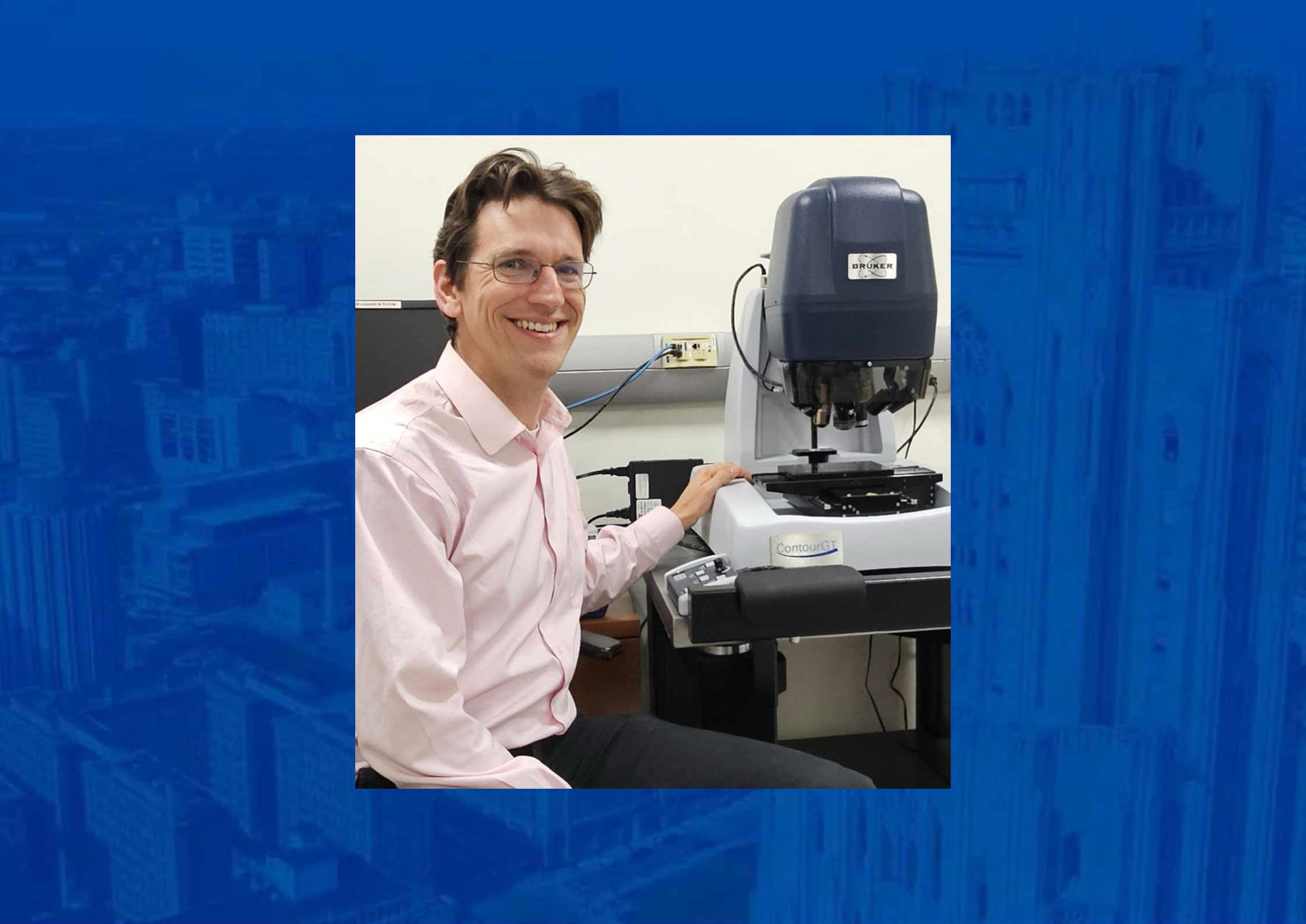
Above: Dr. Jacobs in the MEMS Materials Metrology, Characterization, and Learning Laboratory with one of its 3D microscopes, the Bruker Contour GT-I optical profilometer which measures surface topography in a non-contact, non-destructive way.
Surfaces impact everything in our daily lives – and we impact them. For Tevis Jacobs, those surfaces can unlock secrets to improve them for thousands of uses – and earned him the coveted Startup of the Year Award from the University of Pittsburgh.
Jacobs, who is the William Kepler Whiteford Professor of Mechanical and Materials Science in Pitt’s Swanson School of Engineering, was one of several Pitt innovators and businesses recognized by the university’s Celebration of Innovation and Entrepreneurship, November 12, 2024, at the Courtyard by Marriott Pittsburgh University Center. The annual event is hosted by the Office of Innovation and Entrepreneurship.
“Humans encounter countless surfaces every day, but we rarely even think of our interactions with them unless a machine breaks down or our shoes slip on the floor,” Jacobs says. “For over a decade, my group has been focused on surfaces and how to make them better. We developed not just a science-based approach but also integrated machine learning in a unique combination that allows us to do what no one else can do. By taking a nanoscale look at how surfaces interact, we are improving production efficiency across many technologies from metals to medical devices and even footwear.”
Surface Design Solutions emerged from the research of Jacobs’ lab, which focuses on surfaces and how to make them perform better, whether that is to be more – or less – slip-resistant, more bio-compatible, or less bio-compatible. Surface Design has developed a machine-learning platform, optimized with thousands of prior surface analyses, that delivers robust, physics-informed analysis of surface conditions for any production environment.
Using existing data from the customer’s manufacturing environment, its patented algorithms build predictive models that pinpoint performance indicators and inform production efficiency, delivering its analysis in seconds, not weeks that traditional trial-and-error testing requires. The platform is broadly applicable to a wide range of industries from powdered metal industrial components to flooring to medical devices.
“Tevis and his students have given researchers a new perspective on how surfaces interact and how we can improve them. And thanks to recent advances in AI and computational modeling, not only can they see those surfaces, but they can also alter materials at the nanoscale to improve their functionality at lower costs,” noted Brian Gleeson, Harry S. Tack Professor and MEMS Department Chair. “Pitt’s focus on innovation and entrepreneurship allows faculty like Tevis to spin out their ideas into commercial products and also recruit former students as employees.”
For example, Luke Thimons was a PhD student in Jacobs’ lab who took a job with industry after completing his studies. After the formation of Surface Design, Jacobs approached him to join the company, which he accepted almost instantly. He is now director of customer success where he is the company’s interface with its initial customers to help them implement the platform and bring learning back to the company for refining the user experience.
“This is the one day we set aside each year to pause briefly from the daily whirlwind of invention disclosure submissions, patent filings, pitch competitions, entrepreneurship education programs, mentorship and coaching consultations, license negotiations, industry outreach, and so much more – to reflect on the impact that Pitt innovators and regional business owners are making on our economy and the world at large,” said Evan Facher, Vice Chancellor for Innovation and Entrepreneurship and Associate Dean for Commercial Translation at the Pitt School of Medicine.
###
About the Innovation Institute
The Innovation Institute, one of the four operating units of the OIE, protects and manages intellectual property generated by Pitt innovators. It also provides programs, services, and funding they need to assess the commercial potential of their innovation and accelerate on the path to market. Coordinating with partners across the university, as well as external partners, the Innovation Institute then helps launch innovations into the world through the licensing of Pitt-developed technologies and the formation of startups.