
To Flip or Not to Flip
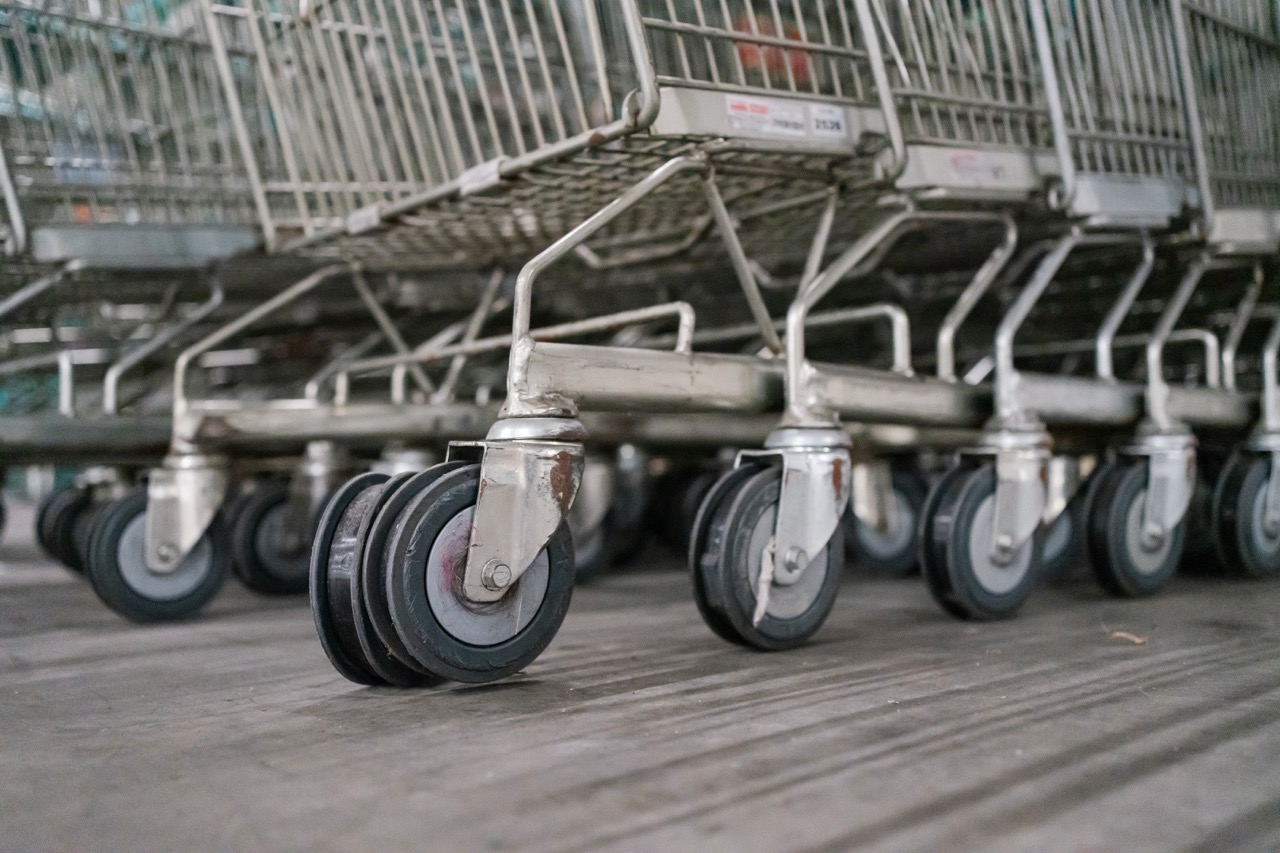
At your local grocery store, you pull free a shopping cart from the long row that begins all the way back at the wall. It’s a rickety cart, like the one you had last week, its front-left wheel twirling like a top while the others squeal. What would it be like, you wonder, to reach that elusive first cart, a cart surely so sturdy, all its wheels well-oiled and touching ground?
Anything stacked, or queued—from shopping carts or plates at a buffet to wooden pallets or power tools for rent at a hardware store—creates a challenge when the items at the top or front are easier to access and thus most used. “Companies must decide whether to let frequently used items wear down more quickly or spend time and energy flipping, or inverting, the stack to ensure more uniform usage,” said Lisa Maillart, Professor and Interim Department Chair of Industrial Engineering.
Research by Maillart and co-authors Mahboubeh Madadi, Mohammadhossein Heydari, Richard Cassady, and Shengfan Zhang highlights the value of flipping the stack. The team has developed a novel model and algorithms that companies can use to find the optimal time to invert items and to replace them, lowering long-term maintenance costs.

The research is published in the article “Erlang loss systems with shortest idle server first service discipline: Maintenance considerations” (DOI: 10.1080/24725854.2022.21499906). IISE Transactions Operations Engineering and Analytics selected this article as a best paper over the last year. At a panel recognizing these best papers, Maillart presented the research at the IISE Annual Conference & Expo 2025, on June 2, in Atlanta, GA.
The team explored an M/M/n/n model of an Erlang loss system, a system developed in 1917 by a Danish scientist Agner Krarup Erlang to predict waiting times in call centers. They considered items in the Shortest Idle Server First (SISF) routing policy, where those items most recently returned, and thus at the top or front of the stack, are used first.
“For items stacked in this model, which is common across many industries, most research has focused on steady-state performance, which covers a long time,” said Maillart. “We wanted to see what happens to the items before they reach steady state—when they are in a transient state.”
The researchers measured an item’s virtual age, or how much it is used and thus its wear, rather than clock time—or how long it has been available for use.
“In our modeling, we found that the use of items at the bottom of a stack is initially almost nothing. But if you flip the stack, that rate increases 15 to 16 percent,” said Madadi, first author of the paper and Associate Professor of Business Analytics in the Lucas College and Graduate School of Business at San Jose State University. “For companies weighing whether to flip, our modeling shows that inverting a stack dramatically equalizes utilization and wear. We also found that if items in use during the inversion are replaced at the bottom, it will do much better.”
In addition to determining the optimal time and manner to invert various items, their model identifies the best time to replace them entirely. “Determining when to invert and replace items of course depends on the item itself, how many are in use, and the usage level,” said Maillart. “This research provides the framework companies can use to determine the timing based on their unique situations.”
Companies can also find the percent reduction in maintenance cost rate in various instances. The research found that companies could save between six to fifteen percent in maintenance costs by flipping and replacing at the optimal time over not doing anything.
“Too often, maintenance can be an afterthought for companies, one that can be costly,” said Maillart. “The ability to compute for the optimal time to flip and replace didn’t exist before the paper. While theoretical, the research’s implications are practical. It can improve customer experience and save companies money.”