
Quantum-inspired computing drives major advance in simulating turbulence
Peyman Givi is Distinguished Professor of Mechanical Engineering and Materials Science at the University of Pittsburgh Swanson School of Engineering. Lead researcher is Nikita Gourianov, Postdoctoral Research Assistant, Department of Physics, University of Oxford, who also was a joint Pitt/Oxford postdoc supported under a US Air Force Office of Science Research grant when this method was developed. Other investigators include Dieter Jaksch, Professor of Physics, Universität Hamburg; and Stephen B. Pope, Sibley College Professor of Mechanical Engineering Emeritus, Cornell University.
Researchers at the University of Oxford have pioneered a new approach to simulate turbulent systems, based on probabilities. The findings, "Tensor networks enable the calculation of turbulence probability distributions"," were published today, January 29, in the journal Science Advances (doi:10.1126/sciadv.ads5990).
Predicting the dynamics of turbulent fluid flows has long been a central goal for scientists and engineers. Yet, even with modern computing technology, direct and accurate simulation of all but the simplest turbulent flows remains impossible.
This is due to turbulence being characterized by eddies and swirls of various shapes and sizes interacting in chaotic and unpredictable manners. For uses within engineering or weather-prediction, these fluctuations cannot be accurately simulated even by the most powerful supercomputers.
Working with colleagues at Hamburg, Pittsburgh and Cornell, the Oxford researchers reframed the problem in a manner that entirely avoids the need to directly resolve and simulate these turbulent fluctuations. Rather than simulating the troublesome fluctuations directly, they modelled these as random variables distributed according to a probability distribution function. Simulating such probability distributions enabled them to extract all meaningful quantities from the flow (for instance, lift and drag), without having to worry about the chaos of turbulent fluctuations.
Normally, simulating turbulence probability distributions requires solving high-dimensional Fokker-Planck equations – something infeasible to do using classical methods. To overcome this, the team applied a quantum-inspired computing technology developed at the University of Oxford. This method uses “tensor networks” to represent the turbulence probability distributions in a hyper-compressed format that enabled their simulation.
In the study, the quantum-inspired computing algorithm running on a single CPU core required just a few hours to compute that which would take an equivalent classical algorithm several days to do on an entire supercomputer.
Yet this computational speedup is only the beginning: in the future, much greater gains are likely to be had by running the quantum-inspired tensor network algorithm on dedicated hardware, such as tensor processing units and fault-tolerant quantum chips.
According to the researchers, the approach not only questions the current limits of turbulence simulation, but also open the door towards simulating other chaotic systems that can be described probabilistically.
Lead researcher Dr Nikita Gourianov (Department of Physics, University of Oxford) said: “The demonstrated - and future - computational advantage not only opens up new, previously inaccessible areas of turbulence physics for scientific probing, but also beckons next-generation computational fluid dynamics codes. These could end up improving our weather forecasts, make our cars more aerodynamic, increase the efficiency of chemical industries, and more.”
###

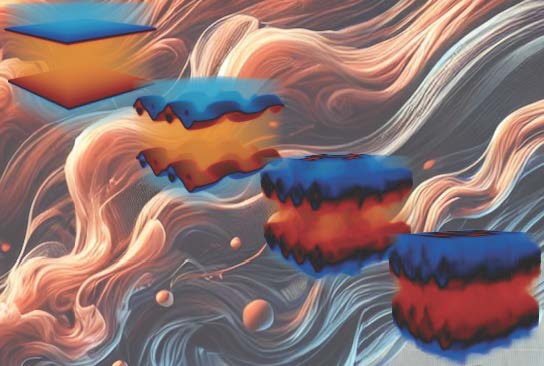
From the article: High-dimensional PDF of a flow undergoing turbulent mixing revealed by TN simulation.