
Not Lost in Translation
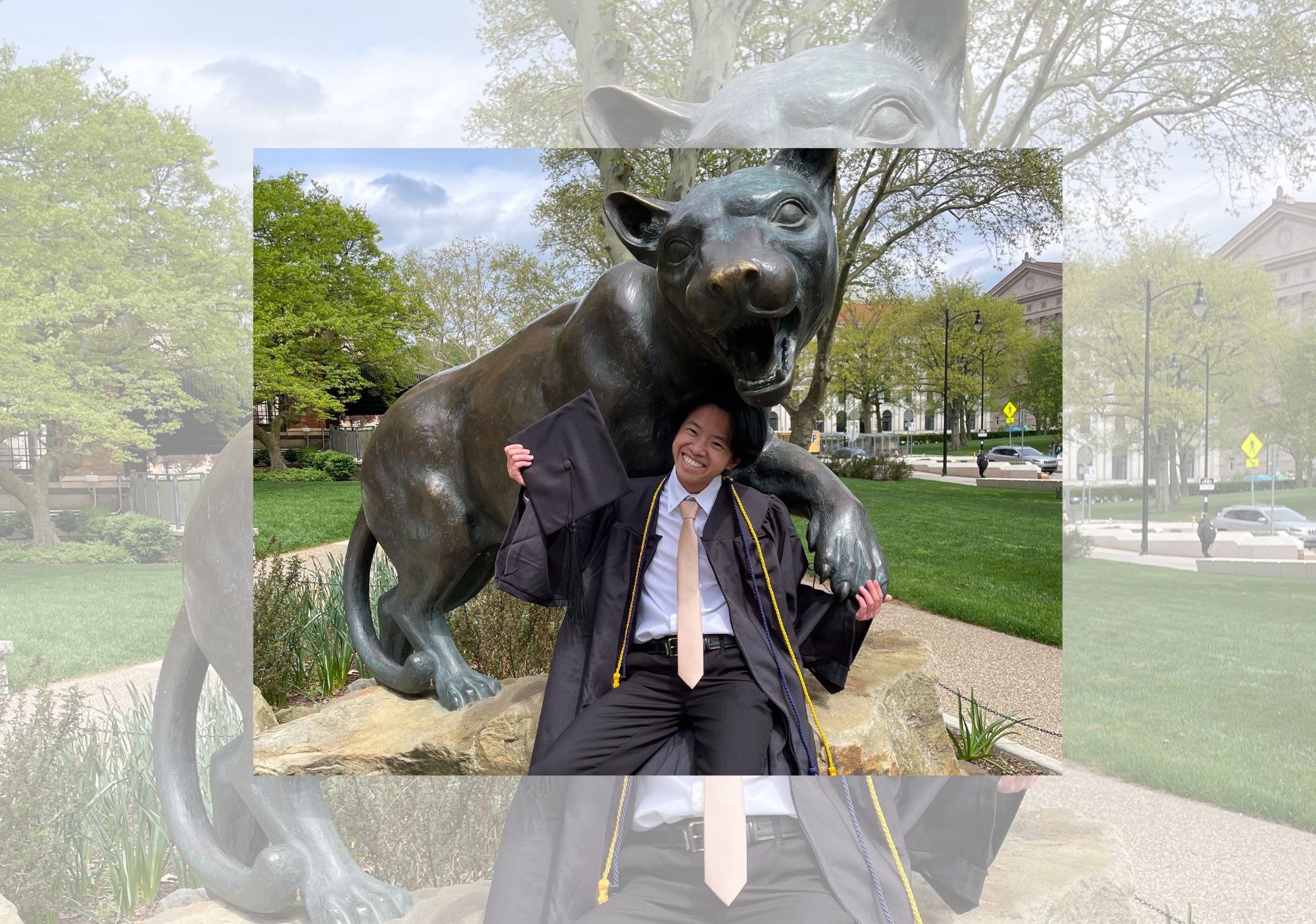
For Percy Curtis, engineering has always been much more than a degree used to land a job. “I’ve always liked helping other people,” he/they said, “and I believe that engineering is a service we provide to humanity.” For Curtis, that service is inextricably linked to the environment and sustainability.
Curtis majored in environmental engineering at the University of Pittsburgh, but he is equally fascinated with languages, especially Japanese, which he began studying in high school. “It’s so different, linguistically, from English, and I took as many Japanese courses at Pitt as my schedule allowed,” Curtis said.
Although he received the George Washington Prize and graduated from the Swanson School of Engineering in 2024 with a 3.98 grade point average, Curtis had no intentions of attending graduate school. An internship and the possibility of studying abroad helped change that, and Curtis recently received a prestigious Ministry of Education, Culture, Sports, Science, and Technology (MEXT) Scholarship to pursue a master’s degree in Sustainability Sciences at the University of Tokyo. In the fall, he will immerse himself in Japanese culture and research how to ensure disaster management plans benefit all people involved.
They seemed the happiest
In 2019, when Curtis toured colleges and universities, he was always careful to talk to the engineering students and ask about their impressions of the program. While these students spoke well of their respective schools, he sensed something unique at Pitt. As he said, “The students here genuinely seemed the happiest.”
Curtis enrolled and weathered the Covid year online. When classes resumed in person, he thrived. He earned straight As and became active in the Civil and Environmental Engineering (CEE) IDEA committee, an organization that builds community so all students and faculty can excel.
As Curtis developed as an engineer and as an active member of the Swanson School, he didn’t lose his love of language. During his sophomore year, he interviewed with Pitt’s Japanese department and began studying the language at the third-year level.
During his final year, Curtis completed his senior design project that focused on improving energy efficiency in older and historic Pittsburgh homes by replacing appliances and sealing openings. The project would provide a perfect jumping off point after earning his degree.
Envisioning a more sustainable future for all
After graduating from Pitt, Curtis interned at the American Council for an Energy-Efficient Economy (ACEEE), a nonprofit research organization working for a cleaner, more sustainable future. He drafted a document on fleet electrification—exploring the logistics, benefits, and other considerations of transitioning fleets of vehicles to electric.
Curtis also drafted a paper on transportation project prioritization. When officials propose projects like upgrading a highway, repairing a bridge, or creating a new road, they assess the need, which can determine which projects are funded.
“For projects like these,” Curtis said, “there should be a scale or a matrix to prioritize the projects. Traditionally, the considerations have focused on safety and economic impact; however, some states are incorporating new ones, such as carbon emissions and equity.”
Curtis explored how different states are incorporating these new factors and outlined best practices in project prioritization. And he grew increasingly interested in the ways organizations and governments determine how projects are funded—and how that affects marginalized communities.
For the opportunity to work with the ACEEE, Curtis in large part credits Pitt. “I was grateful because beyond the research skills I had gained, my senior design project and my involvement with the CEE IDEA committee aligned perfectly with the work I would do at the ACEEE,” he said.
Graduate school is elsewhere
Before working with ACEEE, Curtis had heard little about the methods for prioritizing projects and how important decisions are made—or about how United Nations’ Sustainable Development Goals are implemented.
“Up until that point,” he said, “I had a hard time imagining that equity, if it was even discussed at all, could have a point value.” The process and the ways different states or countries approach it—and how those decisions affect different people—fascinated him.
While Curtis hadn’t planned to attend graduate school, if he did, he knew that it would be abroad. “I would want to immerse myself in a different culture and gain insight from living and working somewhere else,” he said.
Inspired by his experiences at ACEEE, his continued study of the Japanese language, and his interest in Japanese perspectives on the environment and sustainability, he formed a plan. But Curtis needed to find a way to pay for a graduate education overseas.
Since 1954, through its competitive MEXT scholarship program, the Japanese government has helped more than 100,000 students from around the world realize their dream of studying at a university in Japan. Curtis discovered the scholarship and applied. He also applied to the University of Tokyo’s Sustainability Sciences program and was accepted.
This month, he received final confirmation of the MEXT scholarship, which will cover tuition and provide a stipend for living expenses. In the fall, he will begin his master’s work in a country that has long inspired him.
Curtis will research equity in natural disaster management. He will explore how governments and organizations in different countries plan for prevention, evacuation, and post-disaster efforts, and how those plans affect marginalized communities.
“I want to learn how they’re incorporating equity so that low-income and other marginalized communities are not left behind—and how management programs can ensure all people receive the support they need,” Curtis said.
This project and the opportunity to engage with people from around the world to work for a more sustainable, equitable future reflects Curtis’ belief in the purpose of engineering—to serve humanity. It speaks to the spirit with which he approached his time at Pitt, one of endless curiosity and a desire to uplift those around him.