
Coming Up for Air
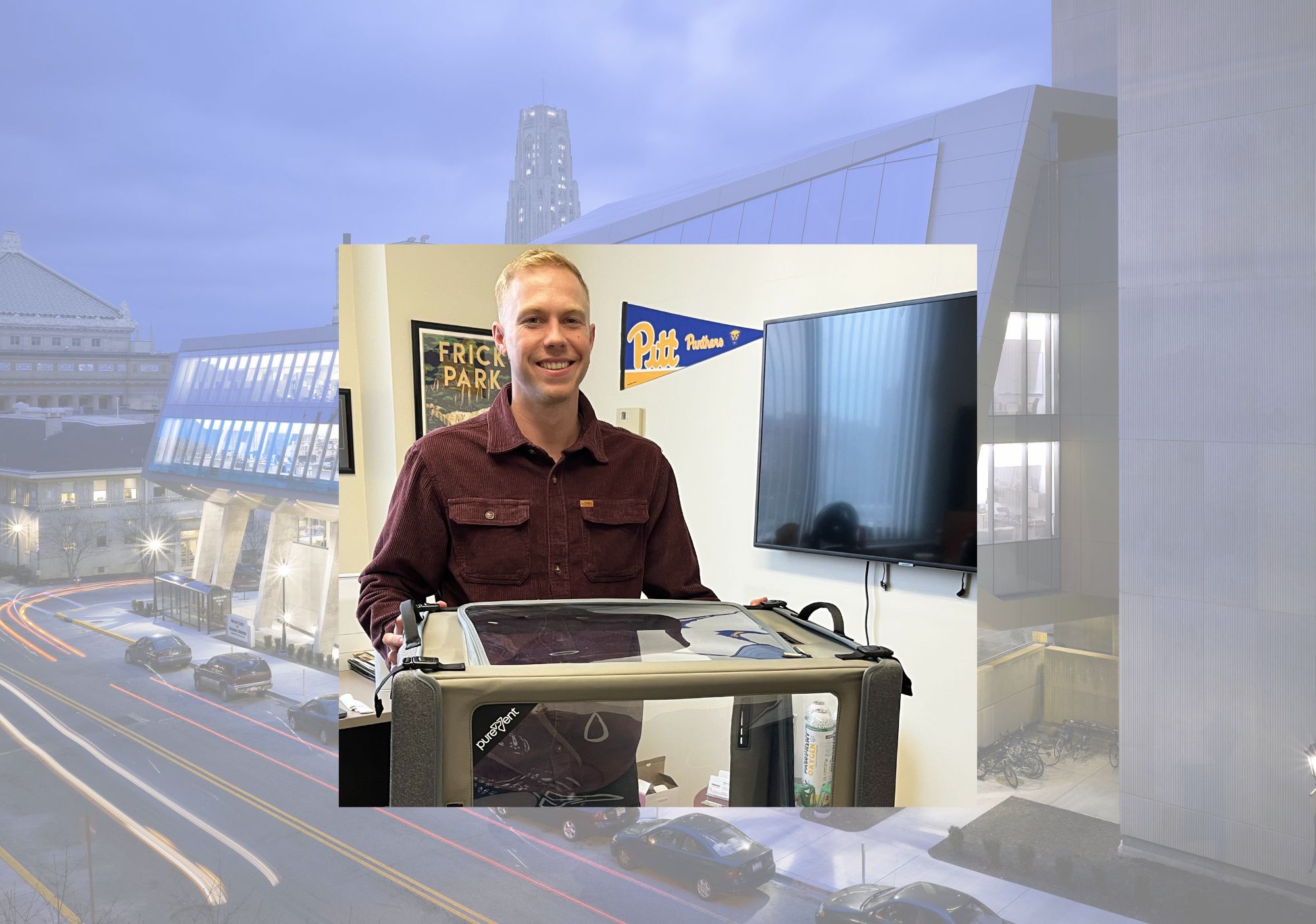
Five years after the launch of its initial product unexpectedly failed, Pittsburgh-based startup Aeronics began shipping its Pawprints Oxygen systems overseas. For Blake Dubé, cofounder and CEO and University of Pittsburgh graduate (BS SSOE ’17), the milestone marked an incredible high. Dubé knows well the highs and lows of starting a business from scratch but credits his engineering degree, a great team, and a desire to make a difference in the lives of others with helping him to navigate them.
In 2013, when Dubé enrolled in Pitt’s Swanson School of Engineering, he had no intentions of running a startup. He was unsure which branch of engineering he’d pursue. He just liked to understand how things worked. He liked solving problems.
During his second semester, while writing what he thought was a bioengineering paper, he realized, “What I was drawn to—what I was really doing—was chemical engineering.”
What followed his sophomore year, as he took his first chemical engineering courses, “was humbling.” Yet he would take a class with Professor Christopher Wilmer, who would become an invaluable mentor, pushing Dubé to take risks and to put himself into positions so that “something can happen.”
An unlikely outcome of early rejection
During his sophomore year, like so many in his class, Dubé applied for internships, but in the competitive landscape, he didn’t land one. Though he wasn’t surprised, it was a setback. He figured he’d return to something familiar—his hometown of York, Pennsylvania, and the grocery store where he’d worked so many summers.
But Dubé hoped to stay in Pittsburgh and be closer to his girlfriend, now wife. He found a research opportunity in Wilmer’s lab, where he would work with a future business partner, graduate student Alec Kaija.
That summer and into his junior year, Dubé threw himself into computational research, exploring the limits of gas storage using hypothetical materials. With Kaija, he helped formulate an idea to create portable, efficient, lightweight oxygen tanks for personal use.
That spring, he and Kaija entered Pitt’s Randall Family Big Idea competition (now the Big Idea Competition), where Pitt students gain firsthand experience developing and pitching ideas. The competition, understanding the power of diverse ideas, requires interdisciplinary teams. Dubé turned to his longtime friend Mark Spitz, in Pitt’s School of Education, whose entrepreneurial spirit always impressed him.
The team won first place, receiving $25,000.
Getting in the reps
As the idea of starting a company took hold, they applied for a provisional patent, and Spitz, Aeronic’s COO, began looking for any opportunity to practice their pitch. “We’d pitch to anyone who would listen," Dubé said. "Mark even signed us up for a competition at the business school, to pitch ways to improve pizza sales.”
Recognizing that public speaking wasn’t a strength, Dubé threw himself into jobs that would require him to talk to groups. He worked as a docent at the Carnegie Museum of Natural History and later delivered tours of the Swanson School of Engineering.
In the spring of 2017, at Princeton University’s TigerLaunch Competition, they fended off many Ivy League teams to win second place and a $10,000 prize. At Pitt’s Blast Furnace Demo Day, they placed first.
These highs were great but never lasted long. The team would miss out on competitions or fumble a pitch. New doubts about starting a company would surface.
To risk or not to risk
During his junior year, Dubé again applied for internships and this time got one. He loved it. The company, BASF, set him to work on one project: devise a system to cut through a polymer used in jounce bumpers without melting it. Countless of Dubé’s solutions failed until he found and presented one that would work: water.
The company offered Dubé a job and with it came anguish. He enjoyed the work, but could he give up his plan of starting Aeronics? They’d made it so far. But—what if it failed? What if he was giving up an amazing, stable opportunity?
He asked anyone who’d listen what he should do. It was his professor Steven Little who said, “You’re the only one who knows that answer.”
Dubé earned his BS in engineering—and declined the job.
Free falling
What followed were more swings up and down. “Our product didn’t exist,” Dubé said. “It took a lot of research and development."
The team attended a 14-week Quake Capital accelerator program in New York City, meeting entrepreneurs, delivering their pitch, and gaining invaluable experience.
They opened an office and found a manufacturer willing to give them a shot.
Finally, in the fall of 2018, it was time to launch. They had 10,000 units. But because of an unforeseen chemical reaction that they found during quality control, the team realized they couldn’t bring it to market yet.
They had invested so much time, energy, and money. Dubé felt like he’d just run off a cliff, like Wile E. Coyote in the old cartoon, and was suspended in midair, about to plummet.
Don’t fall in love with your ideas
“The thing about these highs and lows,” said Dubé, “is that if you try to chart them, it looks dramatic, but in the moment, your actual feelings sail way off the page.”
Luckily, this lowest of lows couldn’t linger too long. Dubé and Spitz had been renting a house from a veterinarian who’d already inspired a new idea: portable oxygen systems for animals.
In the background, the Aeronics team had been working on the idea and within two months launched their second product, Pawprint Oxygen, lightweight tanks that vets and pet owners can use to keep pets alive during an emergency.
The new system didn’t involve their novel technology, but it met a need and saved pets’ lives. As Dubé said, “I learned an important lesson about not falling in love with your ideas.”
“An Out-of-Town Mask Designer”
It was slow at first, selling a new product, but with the same energy they’d put into practicing pitches, they visited as many veterinarian offices and conferences as they could. Word spread, and orders increased.
Then Covid hit and they adapted, finding new ways to connect online.
Positive reviews of the product rolled in, and a year after the launch, Pawprint Oxygen was in 100 animal hospitals. A year later, that number had jumped to 1,000.
While each milestone brought new highs, Dubé still experienced the lows of growing a company and finding the right employees. It helped when they made the right hire, or when they solved a new problem, like building a canine lung model so that they could design and patent their own oxygen mask for pets.
The company reached a new plateau when they could begin donating their products. It was in Denver, in June of 2023, doing just that, where Dubé was given a new title. A reporter, reporting on the donation of 120 pet oxygen masks to firefighters, referred to him as an “out-of-town mask designer.”
The title amused Dubé and his friends, but it revealed something significant: the products that he helped to develop were making a difference not just around Western Pennsylvania and the surrounding states, but across the country.
Across the pond
In September of 2024, after a two-year effort, Pawprint Oxygen shipped to Europe. More recently, the company launched a pet oxygen chamber and, during the fires that ravaged Los Angeles, matched donations to provide enough pet masks for every L.A. fire truck.
With these new highs, the initial launch of their novel product seems further and further away, and while he knows new challenges await, Dubé feels more prepared to come up for air.
Although he has less time to actively engineer these days, he is still buoyed by his four years at Pitt. “They teach you how to solve problems and how to work hard. I was lucky to have mentors who pushed me to buck the constraints and accept uncertainty.”
He is also inspired by the team that he and Spitz have assembled. Their Bloomfield office bustles with dogs and activity as employees pack orders and talk directly to customers.
“I understand now,” Dubé said, “the importance of taking time to pause and celebrate successes and the team here that makes this office so amazing.”