
Securing Assets in the Space Domain
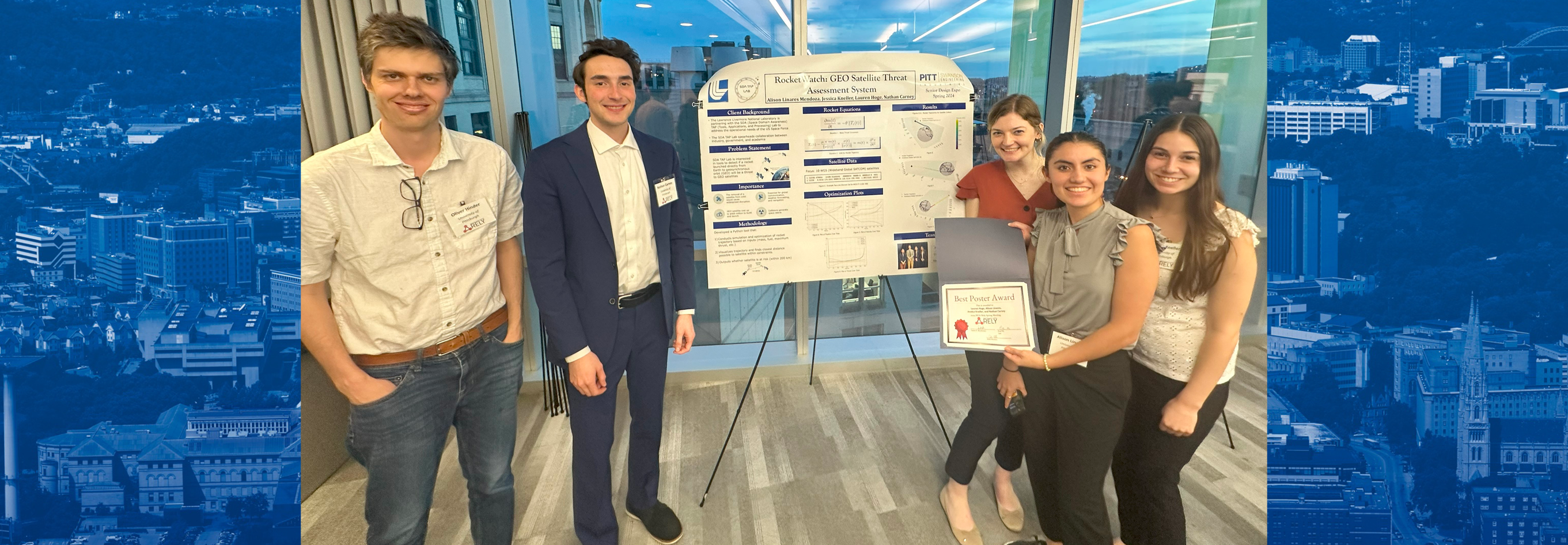
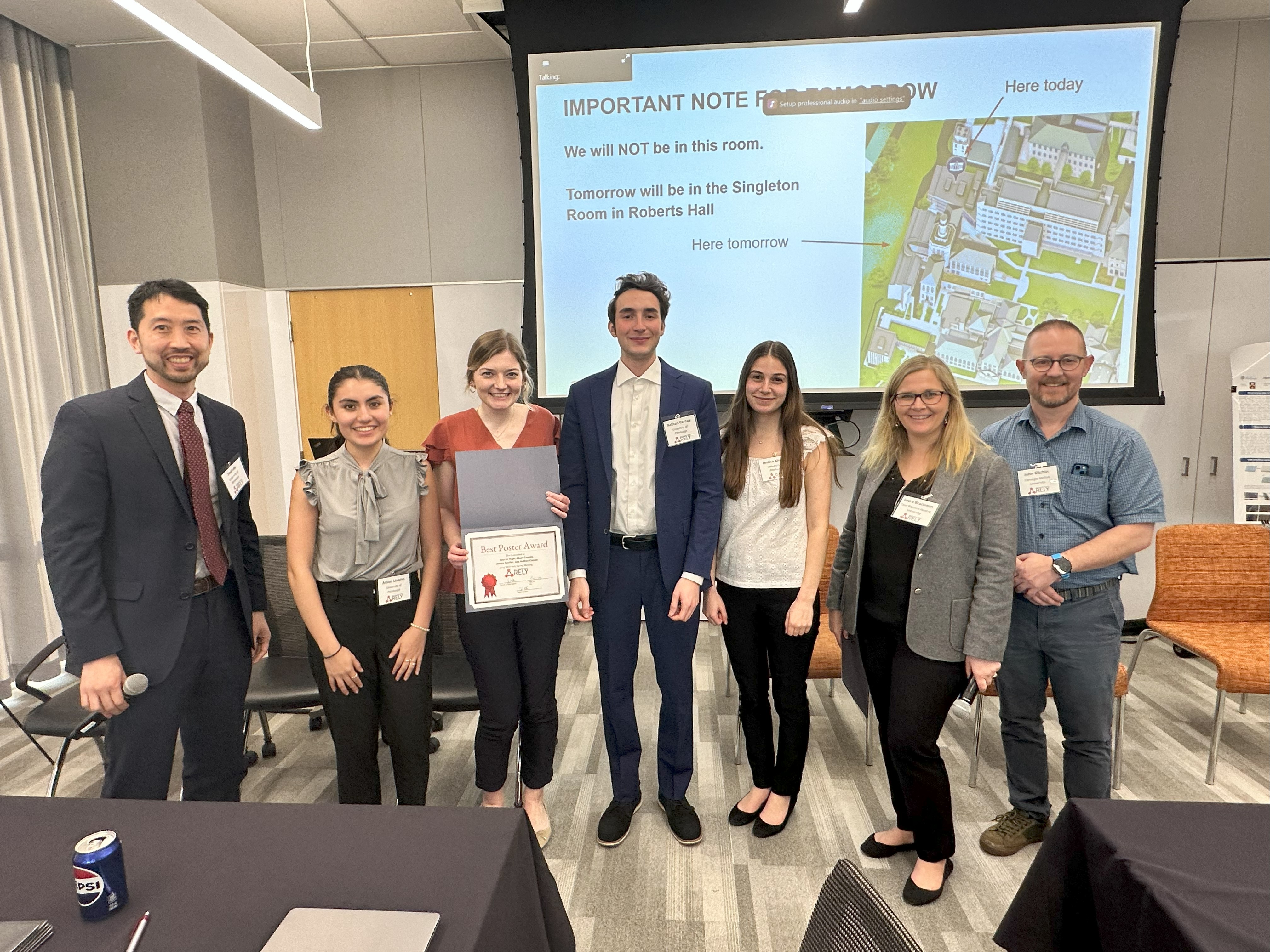
Above: (from left to right) Oliver Hinder, assistant professor of industrial engineering; Nathan Carney; Lauren Hoge; Alison Linares Mendoza; and Jessica Kneller with their Best Poster Award at the MDS-Rely 2024 Spring Meeting.
Orbiting at 26,000 miles above Earth, geosynchronous satellites are critical for maintaining stable communication links, supporting global positioning systems (GPS), observing and forecasting the weather, and ensuring national security and defense.
But what monitors their safety?
A team of industrial engineering seniors at the University of Pittsburgh created RocketWatch, a software tool that detects potential rocket threats to geosynchronous orbit satellites. Nathan Carney, Lauren Hoge, Jessica Kneller, and Alison Linares Mendoza developed RocketWatch as their spring 2024 senior design capstone project at the Swanson School of Engineering.
“RocketWatch provides a simulation-based method to visualize what could happen in the orbital space domain. It takes unidentified rocket variables, like launch location and approximate maximum thrust, and uses the Python programming language to optimize the thrust to hit a certain point in space,” Hoge said. “The goal is to predict how close a rocket can get to a geosynchronous orbit satellite.”
Rocket science… how hard can it be?
To design an ordinary differential equation replicating a rocket’s real-life motion, the students used Newton’s Second Law of Motion (F=ma), taking into consideration the rocket’s changing mass due to fuel consumption and distance-dependent gravitational forces. The team coded their equation using Python and confirmed it was accurate by replicating a rocket’s orbit around Earth.
The team’s final step was converting the Python script into an optimization problem using a Pyomo Ipopt Solver, which also helped create a three-dimensional visual of a rocket’s orbit and trajectory. This solver is an open-source framework for multiscale process modeling, optimization, and advanced analytics.
“Our objective was to minimize the distance of a rocket and satellite within a six- to eight-hour time frame,” Carney said. “That’s where the ordinary differential equation we developed came into play. It controls the rocket’s motion by adjusting the engine power at each step in an attempt to minimize its distance from a satellite.”
We have liftoff
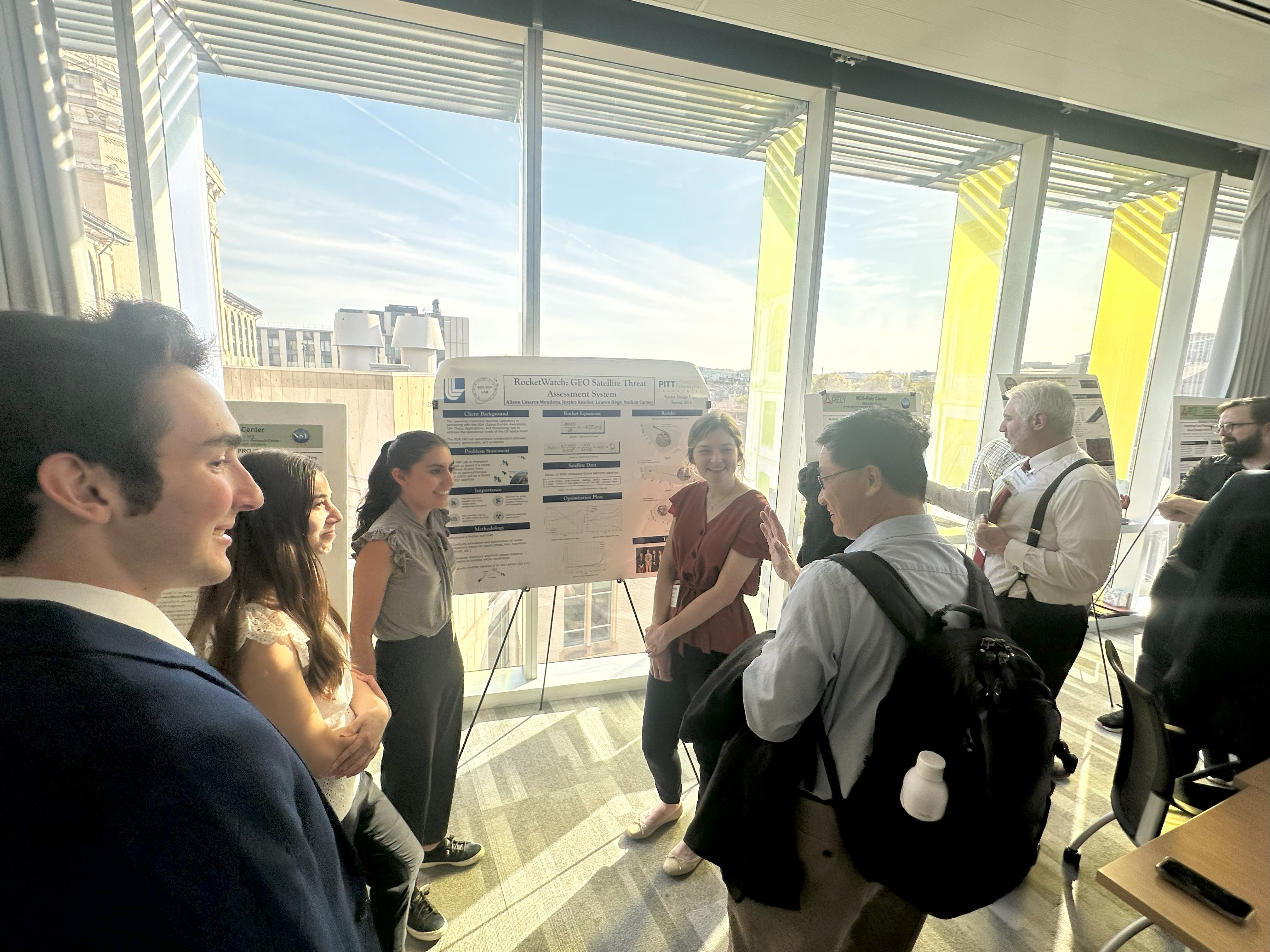
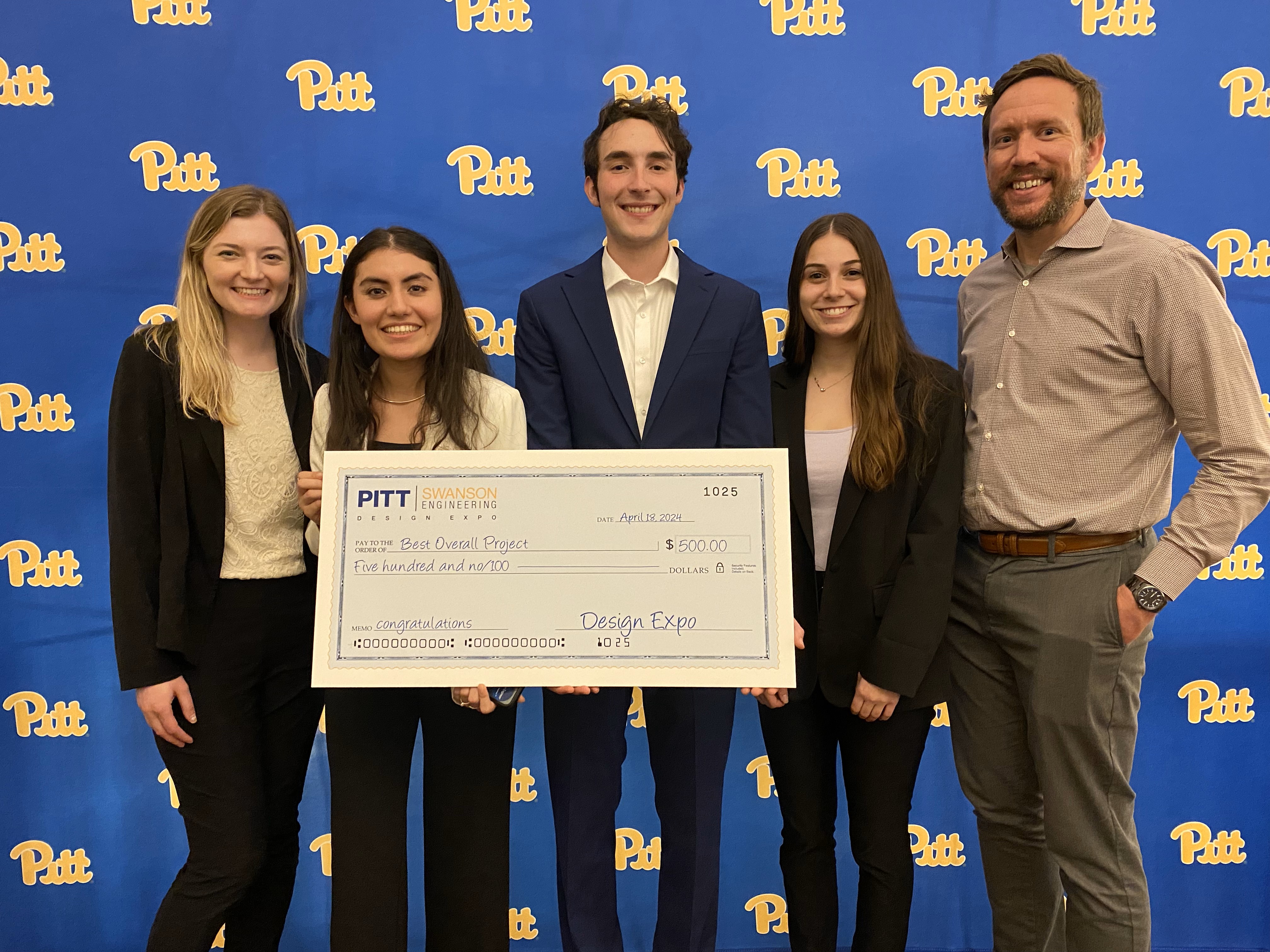
RocketWatch won Best Poster at the MDS-Rely 2024 Spring Meeting, and at the Swanson School’s Spring 2024 Design Expo, they won First Place in Industrial Engineering and Best Overall Project. The team credits making their presentation user-friendly and easy to follow so audience members could understand the software’s value.
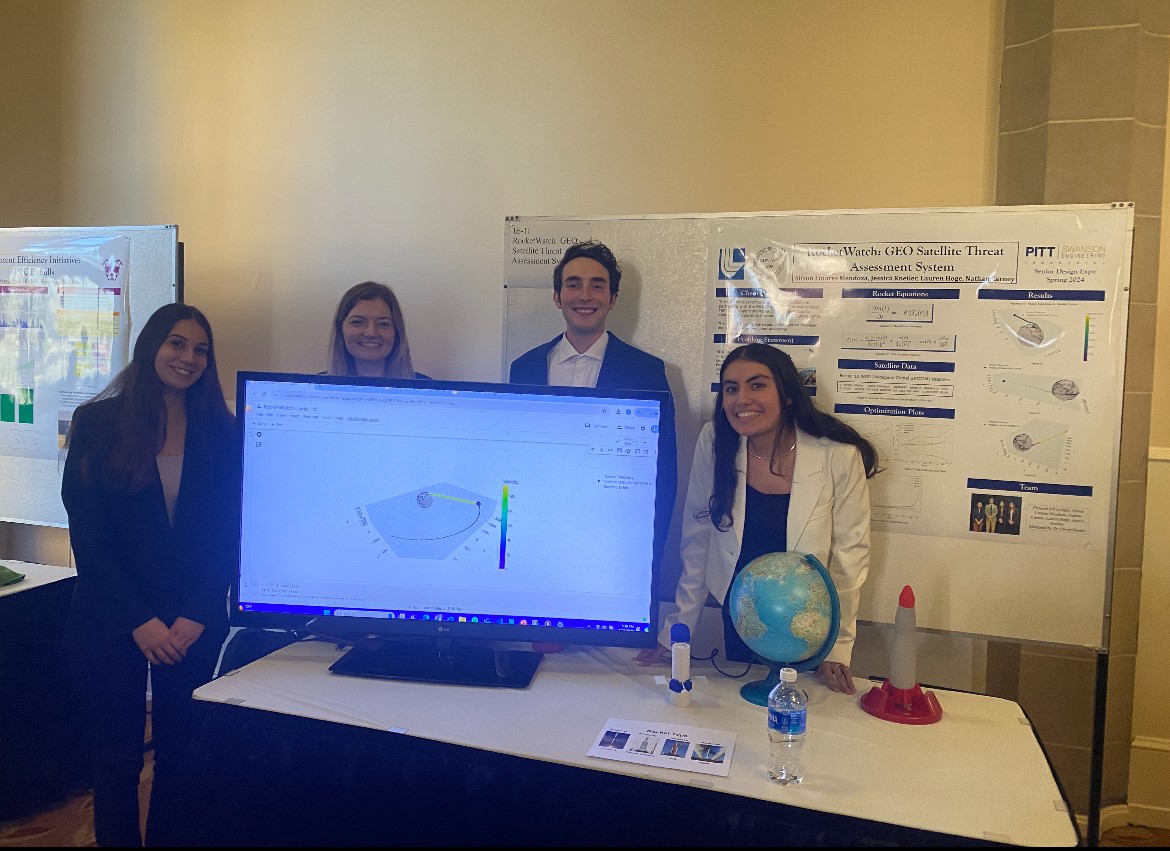
“We developed a simple, three-step process where a visitor could select a rocket, its constraints and launch location to see if any geosynchronous orbit satellites were at risk,” Mendoza said. “We also used a large television screen and globe so people could visualize their choices and watch the code run in real-time.”
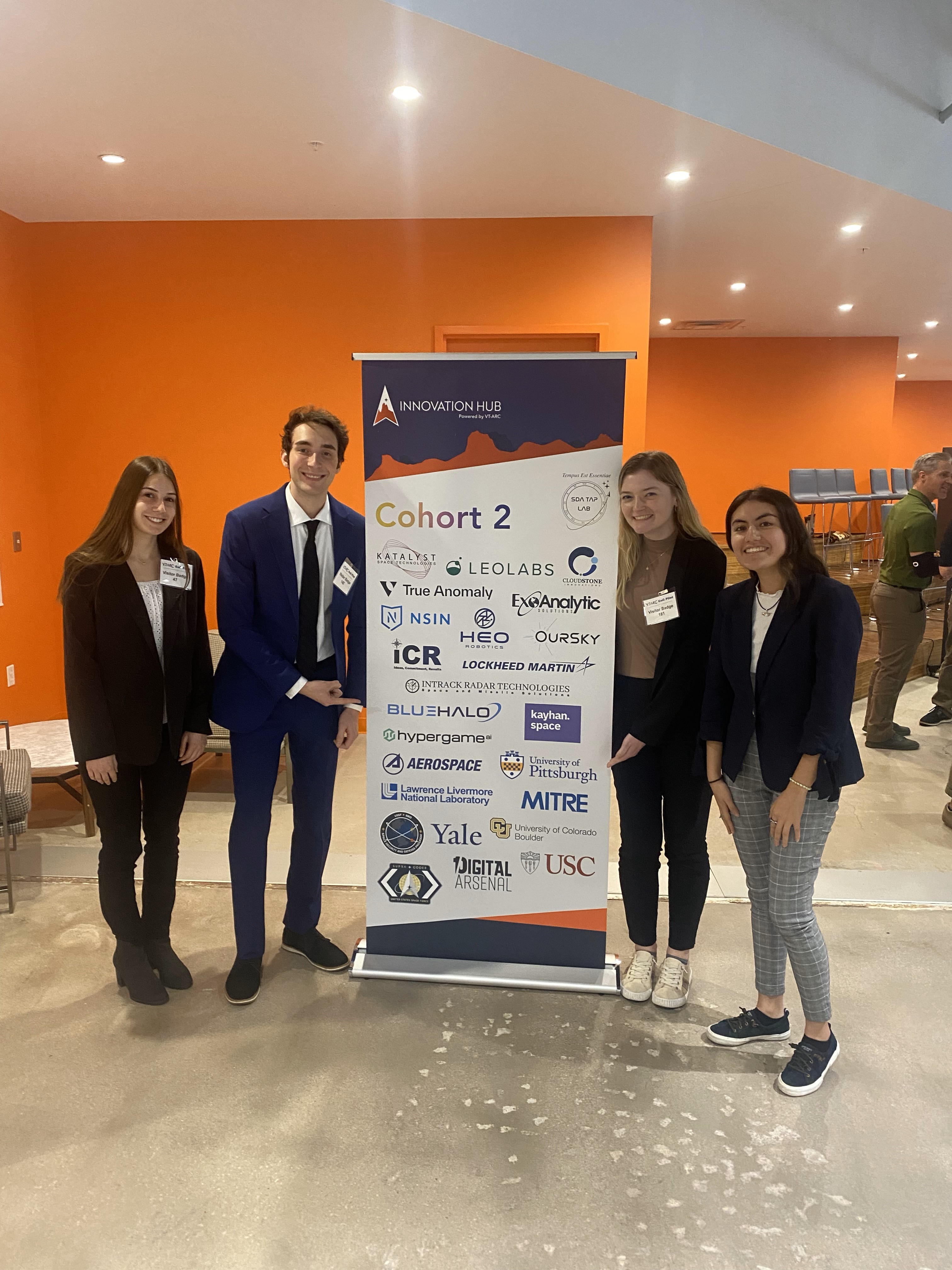
The RocketWatch project is part of the Space Domain Awareness Tools, Applications, and Processing Laboratory’s (SDA TAP Lab) Apollo Accelerator Program, which includes other universities and companies that work on various aspects of space domain awareness. The National Security Innovation Network (NSIN) sponsored the team’s trip to Colorado Springs, Colorado, for SDA TAP Lab’s Demo Day where the team demonstrated how their project fits into larger mission scopes.
“We met with our client at SDA TAP each week during the semester, so one of the most important things about presenting this project at the demo day was meeting them in person,” Kneller said. “It was a highlight to meet students like us who are just beginning their careers and professionals who have been doing this kind of work for decades.”
Jason Bernstein, a postdoctoral associate with the Lawrence Livermore National Laboratory, and Oliver Hinder, assistant professor of industrial engineering, provided advisory support throughout the semester.
“I was proud to witness the students begin the semester with minimal knowledge in rocket physics and nonlinear optimization, and by the end, deliver an outstanding demonstration of their skills in their final presentation and report,” Hinder said.

Mendoza is currently working at Apple in Cupertino, California, as a program manager for their manufacturing design team. Carney is completing an internship with the US Navy’s Carderock Division in Washington, DC, and aims to turn his position into full-time employment. Later this summer, Lauren Hoge will begin work at Carnegie Mellon University’s Software Engineering Institute as a data scientist. Kneller is currently interviewing for positions and looks forward to joining the industry later this summer.
The RocketWatch team would like to thank Oliver Hinder, assistant professor of industrial engineering; Major Sean Allen, Chief of the (SDA TAP) Laboratory; Jason Bernstein; Paul Leu, professor of industrial engineering, BP Faculty Fellow and MDS-Rely Partner Site Director; Scott Streiner, assistant professor of industrial engineering; and Andy Tennant, Region Engagement Principal - West Virginia at (NSIN), for their mentorship and support.