Materials, Completed
Toward Using Microbes For Sustainable Construction Materials: A Feasibility Study
Reinforced Concrete (RC) structures are susceptible to damage from long-term exposure to chloride-based compounds (e.g., from marine environments or deicers) and/or repeated freeze/thaw cycles. To mitigate damage and degradation from environmental loading, an estimated $16 billion per year is spent on the rehabilitation of RC structures using cementitious patching materials and/or chemical treatments, which contribute to pollution and require repeated application and maintenance.
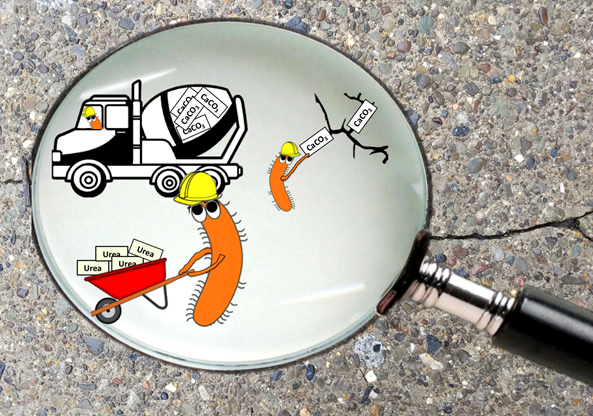
To mitigate these detrimental environmental impacts, this study evaluated the feasibility of increasing the durability, resiliency and sustainability of RC structures by using microbes to provide self-healing properties to prevent water and chloride ingress through structural and/or environmental cracking. State-of-the-art research has begun to explore microbial carbonate precipitation (MICP) for limestone, marble and, to a lesser extent, RC restoration. However, many challenges remain including:
- Finding non-pathogenic microbes capable of MICP;
- Developing methods to ensure microbial viability and even distribution throughout the material to be restored and;
- Creating and evaluating new RC formulations aimed at improving and or sustaining MICP.
This research focused on addressing these challenges, providing insight into the potential application of bio-restoration of RC, which will have far reaching applications for green building design and resilient and sustainable construction.